
Cardiovascular Imaging AI
What Is Cardiovascular Imaging AI?
Cardiovascular imaging AI uses artificial intelligence, especially deep learning, to analyze heart scans (like Echo, MRI, and CT scans) for faster and more accurate detection. It helps in the prediction of heart diseases, identifying subtle plaque, and predicting cardiac events, thus improving workflow efficiency and patient outcomes across all stages of care.
At AnnotationBox, we ensure that the training data for AI and deep learning models are perfect and that these models perform well in analyzing heart scans. Start a consultation to avail our data annotation services.
What Are the Different AI Cardiac Imaging Annotation Services We Provide?
We offer all the services for training artificial intelligence in cardiovascular imaging. Here’s what our services include:

Cardiac MRI Annotation
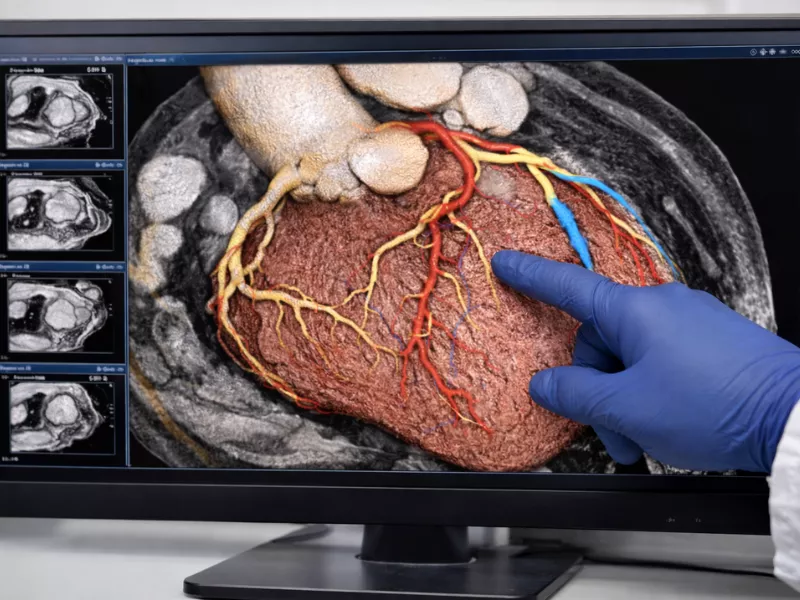
Our medical annotation services experts work on segmenting ventricles, atria, myocardium, valves, and vessels, like the aorta and pulmonary artery. We also offer labeling for ischemia, fibrosis, ejection fraction, and chamber volumes for AI-driven diagnosis. We use 3D multiplanar annotations with DICOM support for precise volume rendering.
Cardiac CT Annotation
We use bounding boxes for coronary stenoses, calcifications, plaques, and heart chambers. Our services also cover semantic segmentation of valves, arteries, and anomalies like aneurysms. We use multi-sequence viewing for up to 16 DICOM images in regulatory-compliant workflows.

Echocardiography and Ultrasound
Our services for echocardiography and ultrasound include chamber and valve segmentation in 2D/3D views. Further, we use Doppler flow labeling for regurgitation, stenosis, and ejection metrics and real-time event annotation for cardiac motion analysis.
ECG and Holter Monitor Labeling
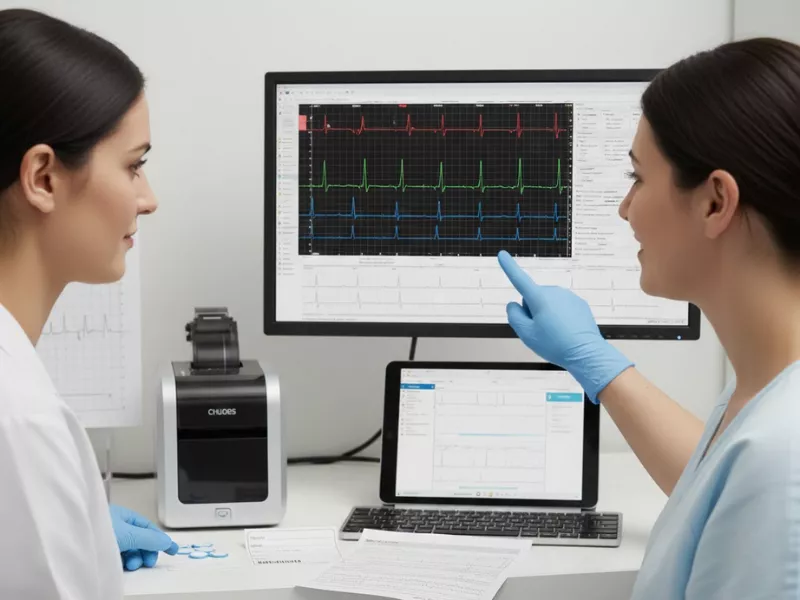
We use waveform annotation for arrhythmias like AFib, PVCs, VT, and rhythm pauses. Our team does 24-48 hours of continuous signal labeling with event categorization and severity scoring. Our annotation solutions aim to help integrate the data with wearable data for longitudinal cardiac monitoring AI. We understand the importance of medical annotation and employ the right techniques for the best results.
Why Choose Us for Data Annotation for Cardiovascular Imaging AI?

Affordable Prices
We offer data annotation at affordable prices. Fill out the order form to get a free quote from us.

Dedicated Project Managers
We assign a dedicated project manager for each project. They help you stay updated, clarify all your doubts, and integrate feedback effectively.

On-Time Delivery
You can be assured of getting your project delivered on time. We ensure the timely delivery of annotated data to train AI models.

24/7 Support
We are available 24/7. Connect with us at any time to get the necessary assistance and help with your annotation.

Customized Solutions
The clients can share their requirements with us, and we will deliver solutions tailored to their needs.

Data Security
AnnotationBox is a GDPR compliant service provider and ensures data protection for all clients. We can assure you that all data will be safe and secure with us.

Accurate Solutions
We guarantee 95% accuracy across all data annotation solutions. You can get in touch with us for a free consultation.

Annotating All Types
We have the best team to annotate all types of data necessary for cardiovascular imaging AI. Hire us for the best solutions today!
Artificial Intelligence in Cardiovascular Imaging: Sub-Domains and Related Fields

Echocardiography AI
This is one of the core sub-domains of AI in cardiovascular imaging. Echocardiography AI automates image acquisition, segmentation of chambers and valves, wall motion analysis, and quantification of ejection fraction or Doppler flows for valvular disease detection. It is also used in deep learning coronary artery disease detection.

Cardiac CT (CCT) AI
Cardiac CT AI is one of the important aspects of cardiology, where the method is used to optimize protocols for dose reduction, segment coronary lumens/walls, detect stenoses, plaques, calcification, and support pre-procedural planning like TAVI.

Cardiac MRI (CMR) AI
The AI applications are used to perform 3D segmentation of myocardium, ventricles, and atria. Machine learning heart imaging diagnosis is also used to identify ischemia/fibrosis and to enable risk stratification for CAD and heart failure.

Interventional Cardiology AI
The essence of AI applied to cardiovascular imaging can be seen in the real-time segmentation in cath labs for stent placement, valve interventions, and motion correction during procedures.

Electrophysiology
AI applications analyze ECG-derived imaging for arrhythmia mapping and substrate characterization in ablation planning.

Multi-Modal Fusion
This field integrates Echo/CT/CMR with EHRs or wearables for holistic prognostication by combining structural, functional, and clinical data.
How to Avail Our Cardiovascular Imaging AI Services?
Sample Data Annotation
The first step after a consultation is to annotate a few sample data points to ensure they follow the guidelines and to initiate a quotation. The process helps to:
- Understand the shortfalls
- Integrate feedback
- Get the necessary approval from the client before moving forward
Annotation and Labeling
Once we get the approval from our client, we start the process of annotating images for machine learning and AI models.
- The project is assigned to our expert annotators
- We use annotation tools to enhance speed and accuracy
Multi-Layered Quality Assurance
We ensure quality annotations for each of our clients. To ensure that the quality is maintained, the project goes through a multi-layered quality assurance:
- Peer review
- Admin review
- Consensus and validation
Secure Delivery and Feedback Integration
The final step is to deliver the annotated data and integrate continuous feedback for further improvement:
- Secure transfer
- Flexible format
- Iterative feedback
Success Stories

How Medical Annotation Improved Efficiency of X-Rays, CT Scans, and MRI Scans
…
We implemented automated medical annotation tools, including deep learning algorithms and computer vision methods, to address these challenges.
“We have done the first phase of review of “AnnotationBox,” to analyze the quality of the instrument annotation project, and we are delighted with the perfect accuracy level.”
– PhD Research Manager, Metropolitan Diagnostic
Read the full case study
Know more
How AnnotationBox’s High-Quality Data Collection Fueled a 30% Improvement in Diagnostic AI Accuracy
…
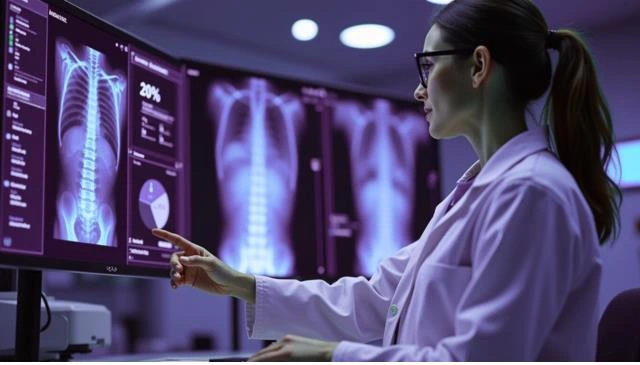
We provided diverse image sourcing, expert medical annotations, and rigorous quality checks to deliver over 10,000 high-quality, privacy-compliant X-ray images to train MedTech’s diagnostic AI effectively and securely.
“AnnotationBox’s expert medical data annotation and quality focus enabled MedTech Innovations to launch their AI platform faster and more accurately, significantly contributing to their product’s success”.
– Christine R. Hawkins, Chief Technology Officer, MedTech Innovations Inc.
Read the full case study
Know more
Frequently Asked Questions
How does AI improve cardiovascular imaging?
AI improves cardiovascular imaging by automating reconstruction techniques, boosting diagnostic precision, and enabling rapid workflows across every modality, like echo and CT. It helps in reducing technical burden while improving reliable interpretation.
Can AI detect heart disease in imaging?
Yes, AI detects heart disease with high diagnostic precision, spotting subtle plaques or ischemia in MRI/CT using deep learning systems. The process helps in critical risk prediction that matches clinician standards using AI cardiac image reconstruction techniques.
Does AI reduce costs in cardiovascular imaging?
Yes, AI reduces costs by optimizing protocols for dose/time savings, automating tasks to cut operational burden, and minimizing repeat scans in high-volume centers.
How does AI aid cardiac intervention planning?
AI aids planning with precise 3D segmentation of vessels/valves from angiograms, providing real-time guidance for TAVI/stents, integrating multimodal information for successful outcomes.
What is the future of AI in nuclear cardiology?
The future offers explainable AI for denoising, dose reduction, and hybrid PET/CT fusion, tackling bias for transparent, clinician-trusted risk prediction in routine workflows.
Are your annotators qualified for cardiovascular imaging?
Yes, our cardiovascular imaging annotators are highly qualified to work on the annotation process and provide accurate data.