

Synthetic data in computer vision annotation is artificially generated imagery that is used to train AI models. It combines automatic labels, zero manual effort, and full control over scene conditions. It directly addresses the core challenge of building CV datasets.
Since real-world data is expensive, slow to label, and often imbalanced, this synthetic data fills all these gaps. The global AI training dataset market, driven by these costs, is growing from USD 2.3 billion in 2023 to an estimated USD 11.7 billion by 2032. In this blog, we will discuss all its methods, strategies, real-world applications, and much more.
Key Takeaways
- Synthetic data generates large, labeled CV datasets without manual annotation, which cuts time and cost significantly.
- It covers rare and dangerous scenarios that are impossible or unsafe to capture in the real world.
- The best results come from combining synthetic and real data, which do not replace one another.
- The methods include 3D rendering engines, GANs, diffusion models, and simulation software.
- Managing the sim-to-real gap through domain adaptation and hybrid training is key to production-ready performance.
What Is Synthetic Data in Computer Vision?
Synthetic data refers to artificially generated images, videos, and annotations that are created computationally and not captured from the real world. In the context of computer vision data, it means AI-ready visuals generated using 3D rendering engines, generative models, or simulation software.
It is not like real photos; this synthetic imagery comes pre-labeled. The generation pipeline knows exactly what’s in every frame, including object positions, bounding boxes, segmentation masks, depth, and more. This removes the need for expensive manual annotation.
Types of Synthetic Data Used in Computer Vision
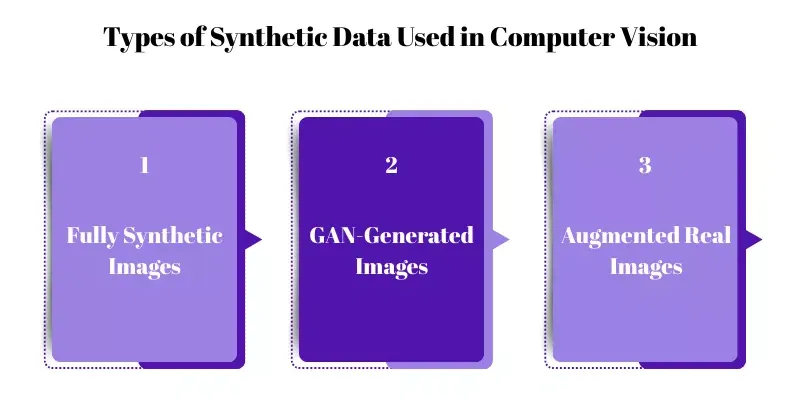
There are 3 main types of computer vision synthetic data annotation services:
Fully Synthetic Images
Built using 3D platforms where every detail, including lighting, angles, and textures, is controlled and annotated automatically.
GAN-Generated Images
It is created by generative AI models like GANs and VAEs. These models learn from real datasets and produce new, realistic-looking samples for data annotation synthetic data.
Augmented Real Images
It is a hybrid method where real image segmentation services are enhanced with synthetic elements like virtual objects, style changes, or modified backgrounds.
How Synthetic Data Generation Works?
Synthetic data generation for computer vision models uses a mix of technologies. It’s core idea is simple: build a virtual environment, take images from it, and export the labels automatically. Here is the whole process:
- Scene design: Developers build 3D environment using different tools.
- Parameter control: Lightning, camera angles, weather, and scene layouts are controlled to create diversity.
- Rendering: The engine outputs photorealistic images using physically based rendering techniques.
- Auto Annotation: Because the system controls the scene, it generates the pixel perfect labels.
- Export: The labeled dataset is packaged and ready for model training.
Why Synthetic Data Matters for Computer Vision Annotation?
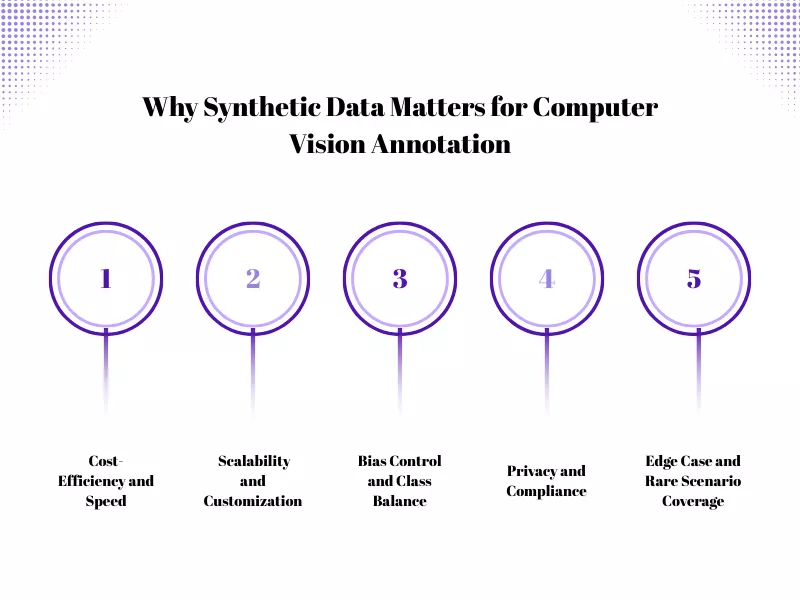
If you see the real-world data collection, then it is very slow, expensive, and on the top of that, incomplete. Synthetic data solves these core challenges that hold back AI development. Here is why it matters for computer vision annotation and the benefits synthetic data CV:
Cost-Efficiency and Speed
Manual data collection and labeling are one of the most expensive parts of building a CV model. Synthetic data platforms can generate various labeled examples in hours. This cuts both the budget and time.
Scalability and Customization
Need 50,000 images of a product under different lighting conditions? Synthetic data will help you with that. You control every variable, including object type, background, angle, weather, etc., without limits. This is one of the best benefits of synthetic data in computer vision.
Bias Control and Class Balance
Real-world datasets are often imbalanced. Some objects or scenarios appear far more than others, which leads to biased models. With synthetic data generation for computer vision models, you can balance classes and make sure it covers everything in all conditions.
Privacy and Compliance
In fields like healthcare and surveillance, collecting real data means dealing with GDPR and other privacy regulations. Synthetic data has no identifiable information, which makes it safe to use, share, and store without any legal issues. This advantages synthetic data annotation computer vision is important.
Edge Case and Rare Scenario Coverage
Some things are impossible to capture in real life. Synthetic environments help you simulate these cases safely and repeatedly, so that your model is ready before they come into the real world.
Methods Used to Generate Synthetic Data for Computer Vision
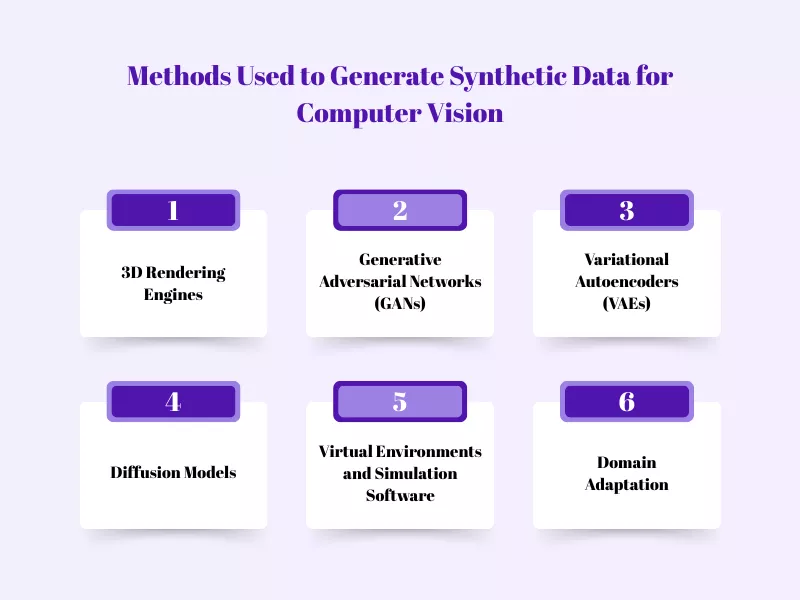
There is no single way to create synthetic imagery. Different methods suit different use cases, team budgets, and realism requirements. Here are the most widely used approaches:
3D Rendering Engines
Many tools help developers to build detailed virtual environments and make photorealistic images from them. Every element, including lighting, camera position, and object placement, is fully controlled.
It is best for industrial inspection, robotics, image annotation for autonomous vehicles, and any use case, precision annotation.
Generative Adversarial Networks (GANs)
GANs use two neural networks, including a generator and a discriminator, which compete to produce highly realistic images. Once they are trained, they can generate new images without labeled input data.
It is best for data augmentation, style transfer, face synthesis, and domain adaptation tasks.
Variational Autoencoders (VAEs)
VAEs encode real images into a compact representation, and then they decode new variations from it. They are more stable than GANs and easier to train, though the output can be less sharp.
It is best for anomaly detection, exploratory data generation, and tasks where interpretability matters.
Diffusion Models
Machine learning diffusion models start with noise and refine it to a realistic image. They power tools and produce some of the highest quality synthetic imagery available today. It is best for high realism augmentation, rare event generation, and a domain adaptation pipeline.
Virtual Environments and Simulation Software
Camera and sensors placed inside these virtual environments capture dynamic scenes with automatic multi-modal labels, including radar, RGB, and LiDAR. It is best for autonomous vehicles, drones, robotics, etc.
Domain Adaptation
This adaptation does not create new data from scratch; it adjusts existing synthetic images to look more like real-world photos. It is best for improving model performance when you have a large synthetic dataset but limited data.
Real-World Data vs. Synthetic Data: A Practical Comparison
Both real vs synthetic data vision types have their own strengths. The key is knowing when to use each and when to combine them:
Strength of Real-World Data
- Captures the actual complexity and noise of the deployed environment.
- Important for final model validation and production testing.
- Reflects the true distribution of real scenarios.
Limitations of Real-World Data Collection
Real-world data is limited as:
- Expensive and slow to collect and label
- Does not have balance with rare events and underrepresented
- Have privacy and compliance risks
- Manual annotation has human err