AI models can’t interpret raw financial data. The fact that financial institutions process millions of data points every day makes financial data annotation an important aspect. The process helps transform unstructured data into labeled training datasets that can help train machine learning models.
The quality of the training data plays a major role in determining whether AI systems can handle tasks like regulatory compliance monitoring, algorithmic trading, or risk assessment in real-world scenarios.
This blog will take you through the meaning of financial data annotation, why it is important in finance and accounting, the key uses, and more, to help you understand the concept and need of data annotation in finance.
Key Takeaways
- Financial data annotation services convert raw financial data into AI-readable training datasets
- High-quality annotation is critical for accurate AI models in finance and accounting
- Common techniques include NER, text classification, sentiment analysis, audio labeling, and document field extraction
- Annotated data improves fraud detection, risk assessment, and regulatory compliance
- AI-driven personalization and customer service rely on well-labeled financial data
- Data annotation enables document automation and operational efficiency
- Algorithmic trading depends on accurate, context-rich annotated datasets
- Best practices include clear guidelines, strong QA, data security, and hybrid human-AI workflows
What Is Financial Data Annotation?
Financial data annotation is the labeling of raw financial data to ensure that artificial intelligence and machine learning models can understand it. The text annotation for finance involves adding tags to key details such as company names, dates, currencies, and transactions to help the algorithms understand what they are analyzing.
The annotators mark specific elements within documents, transactions, or market data using predefined taxonomies. They use a human-in-the-loop process, along with automated tools, to ensure results are accurate. They assign subject-matter experts who understand the finance terms, regulatory requirements, and contextual nuances for better results.
What Are the Techniques Used in Data Annotation for Finance and Accounting?
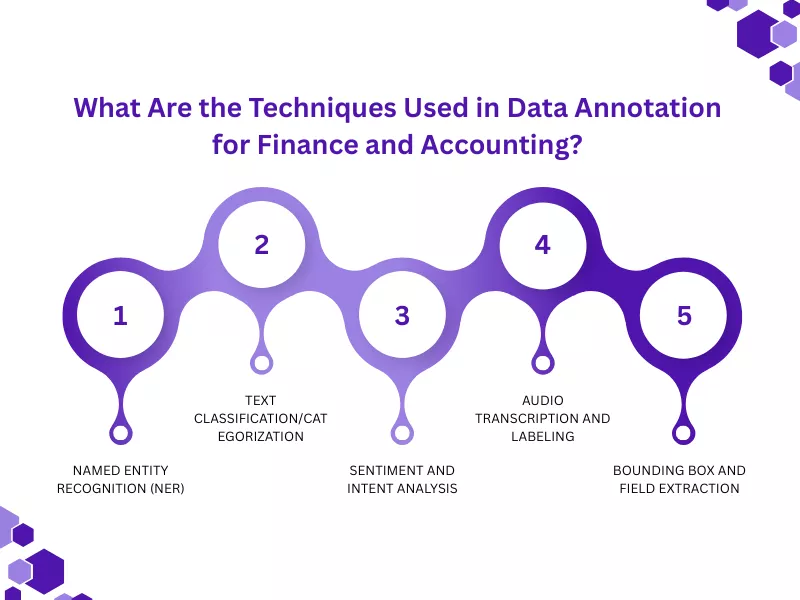
A. Named Entity Recognition (NER)
NER, or Named Entity Recognition, is an important technique for financial data annotation. The technique helps identify and label specific elements in text, like financial reports or contracts, including company names, monetary values, dates, and account numbers. Finance companies avail data annotation services to ensure the accuracy of data.
B. Text Classification/Categorization
Financial documents or text sections are assigned categories like loan applications, compliance reports, or customer inquiries. It can be used for filtering or tagging content for compliance.
C. Sentiment and Intent Analysis
Text from customer interactions or market reports is labeled to determine emotional tone, enabling better understanding of customer needs and the development of trading algorithms. It plays a crucial role in banking with AI. Chatbots are trained to understand customer needs and answer their queries.
D. Audio Transcription and Labeling
Spoken content from earnings calls or customer service interactions is transcribed into text and labeled with speaker identification and sentiment.
E. Bounding Box and Field Extraction
Computer vision is used to process physical or scanned documents, such as invoices, checks, and ID verification forms. The professional annotators draw boxes around specific data fields to teach models to automatically capture relevant data.
All these techniques help in proper data labeling for financial analysis. These train the models to understand the various pieces of information necessary for financial services.
Why Data Annotation in Finance Is Important?

A. Better Fraud Detection
Financial institutions process millions of data points every day. High-quality data annotation, such as tagging historical transactions, helps differentiate legitimate from suspicious data. It trains AI models to recognize unusual patterns and detect fraudulent activity in real time, thereby reducing losses and protecting customers.
B. Better Risk Assessment and Management
Accurate tagging of data points like market trends, economic indicators, and historical loan repayment statuses helps institutions develop more sophisticated models. These models help assess creditworthiness and quantify potential risks in investment and lending decisions.
C. Streamlined Regulatory Compliance
The financial industry is heavily regulated. Accurate data annotation helps automate compliance tasks by identifying and tagging sensitive information such as personally identifiable information (PII), transaction data, and fraud indicators across a massive volume of documents. It helps ensure that the data complies with complex laws such as KYC (Know Your Customer) and AML (Anti-Money Laundering).
D. Personalized Customer Service
Expert data annotation is essential for extracting customer interactions, sentiment, and preferences from sources such as emails, chat logs, and reviews. The annotated data helps train AI models to understand individual customer needs. The process helps financial services to offer customized products, services, and communications, thus increasing customer satisfaction and retention.
E. Operational Efficiency and Document Automation
Countless forms, contracts, and statements are handled by financial firms. Data annotation, along with Optical Character Recognition, trains systems to automatically extract and process information from these documents. As a result, it reduces manual labor and improves processing speed and accuracy.
F. Algorithmic Trading and Investment Strategies
Algorithms that make instant trading decisions need high-quality annotated data that includes market patterns, news sentiment, and historical trends. It helps these AI algorithms to predict market movements.
G. Data Accuracy and Consistency
Raw data can lead to errors and be inconsistent. Data annotation helps add context and structure, thus ensuring data integrity and consistency. This is crucial to make sound and data-driven decisions.
All of these are the benefits of financial data annotation in banking and finance.
What Are the Best Practices for Data Annotation for Financial Services?

A. Establishing Core Guidelines
The first step is to establish detailed guidelines covering all financial terms, types of transactions, and evolving regulations like BCBS 239. Service providers, such as AnnotationBox, use domain-specific experts with the necessary financial training to capture nuances that general annotators miss. It is also necessary to regularly update guidelines to maintain consistency across large datasets.
B. Quality Assurance
It is necessary to implement multi-layer reviews, especially on high-risk data. The initial annotation is done by automated tools, then reviewed by an annotator, followed by peer review and a final admin review. The service provides track-level KPIs, such as accuracy, inter-annotator agreement, and error rates.
C. Security Measures
It is necessary to prioritize data encryption in transit and at rest, role-based access controls, audit trails, and compliance with SOC 2 standards. Use SLAs for breaches to avoid sharing the full raw dataset.
D. Hybrid Approach
The best way to annotate financial data is by combining human expertise with automation. The annotation tools suggest labels for the data, which is then sent for human review. It helps balance speed and judgment when dealing with complex financial data. This way, the service providers optimize workflows while ensuring contextual accuracy.
How to Annotate Financial Data for Machine Learning?
Annotating financial data for machine learning involves converting raw data into labeled signals using domain expertise, clear guidelines, and a combination of AI and human annotators. The annotation process includes:
- Defining Objectives – Understanding the problem you are solving
- Data Collection and Preprocessing – Gathering structured and unstructured data
- Establishing Guidelines – Creating rules for annotators
- Selecting the Annotation Type – Deciding on binary, multi-class, regression, or text tagging
- Annotation (Human and AI) – AI suggests labels, and humans review them for accurate results
- Quality Control – Multi-layered reviews for high accuracy
- Format Data – Deliver labeled data in AI AI-compatible format
What are the Financial Data Annotation Guidelines for Startups?
Startups that handle financial data must follow the right guidelines to ensure proper training of AI and ML models. Here are a few guidelines for startups:
- Define clear annotation objectives
- Start with high-value data first
- Standardize labeling taxonomies
- Ensure data privacy and compliance
- Adopt a human-in-the-loop approach
- Implement quality control checks
- Document annotation guidelines clearly
- Focus on accuracy over volume
- Use domain-specific annotators
- Plan for scalability early
- Review and retrain models continuously
- Track performance metrics
AnnotationBox: The Best Service Provider for Financial Data Annotation

AnnotationBox has the best team of annotators and all the necessary resources to annotate data for financial and data annotation services for fintech organizations. We understand the role of AI in financial data annotation and ensure that our clients get accurately annotated data to train their AI and machine learning models.
We follow human-in-the-loop approach to ensure the accuracy of all data. Our solutions ensure that your AI and ML models can help with risk assessment, data analysis, fraud detection, and more.
Our annotation services improve ML models to create a secure user experience by analyzing, prescribing, and predicting outcomes. Give us a call for a consultation and share your requirements to get accurately annotated data.
Frequently Asked Questions
Why is financial data annotation important for AI?
Financial processes such as regulatory compliance and sentiment annotation on customer interactions need precise data annotation. Data annotation enables AI tools in finance to understand the different aspects for proper prediction and financial forecasting.
What types of financial data need annotation?
Financial data that needs annotation is spread across both unstructured and structured data. Here are the different types of financial data that need annotation:
- Transaction data
- Documents and reports
- Text and sentiment data
- Multimedia content
- Market and risk data
How do scalable data annotation and labeling services support fintech companies?
Scalable data annotation and labeling services can handle volumes of financial complex data for leading financial institutions. They combine automated data tools with human review to produce high-quality financial datasets to power AI in financial services for real-time analytics and tracking financial metrics.
What security practices are critical in financial data collection and annotation?
Data security in data collection and annotation prioritizes encryption and compliance for sensitive datasets. It helps ensure that the annotation for AI in finance is protected against all breaches while enabling datasets for AI to support advanced tools for fraud detection and personalized services.
Can automated data improve financial forecasting through annotation?
Automated data combined with expert annotation accelerates the processing of financial statements and market data. It allows AI-powered analytics to make predictions on trends. Human oversight helps prevent issues the models might face with poorly annotated data.
Why choose hybrid approaches for data annotation in AI in financial services?
Hybrid approaches combine automated tools with human expert annotation to handle complex data from financial metrics and statements efficiently. This helps in precise data annotation for AI datasets, thus improving financial processes like risk assessments, fraud detection, etc.

Want To See My Profile — Click Here Shrey Agarwal
- Financial Data Annotation: A Complete Guide for Banking and Finance - January 12, 2026
- Semantic Segmentation vs Instance Segmentation: Key Differences - December 18, 2025
- Human Annotation: 3 Edge Cases Automation Misses - December 4, 2025