In production environments, 3D object detection is more about surviving imperfect data and less about simply detecting objects.
The computer vision technique helps identify, classify, and locate objects in a 3D space. The technique estimates the objects’ position, size, and orientation. However, when compared with 2D object detection, this technique is challenging as it requires spatial, geometric, and volumetric data, instead of analyzing flat pixel arrays.
Prioritizing robustness, speed, and data quality over mere accuracy metrics is crucial in this technique. Here, we will take you through the reasons why 3D object detection is hard and what matters in production in detail.
Key Takeaways
- 3D object detection identifies and localizes objects with depth, size, and orientation.
- It is more complex than 2D due to sparse data, depth ambiguity, occlusion, and higher dimensionality.
- Real-world deployment requires speed, low latency, and computational efficiency.
- Models must generalize to edge cases and maintain temporal consistency.
- It offers superior spatial awareness but demands advanced sensors and heavy processing.
- Widely used in autonomous vehicles, robotics, and AR/VR applications.
What Is 3D Object Detection?
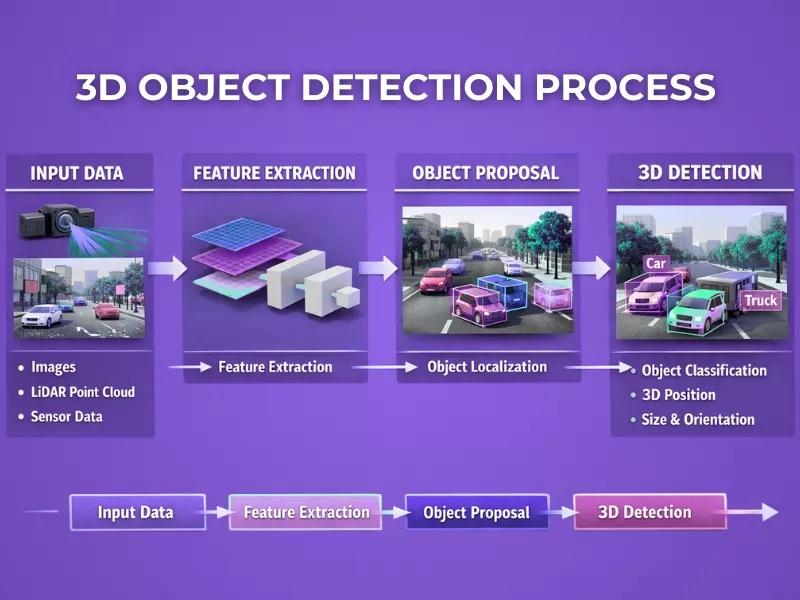
The primary objective of 3D object detection, as mentioned earlier, is to identify, classify, and locate objects in 3D space. Object detection in computer vision started with detecting shapes in flat 2D images, but has now evolved into understanding space and depth through 3D detection.
3D object detection added depth and space to images for computer vision. Presently, machines can understand the position, orientation, and physical dimensions of images. The computer vision technique uses data from sensors like LiDAR or depth cameras to create 3D bounding boxes, thus providing the necessary depth awareness for applications like autonomous vehicles, robotics, and AR/VR.
The Key Aspects and How 3D Object Detection Works Are:
- Sensor data usage – The technique relies on 3D data formats, like point clouds or depth maps, or stereo image pairs to understand the third dimension.
- Output components – Instead of giving a 2D box, it creates a 3D bounding box to define the precise location and pose of the object.
Moving on, we will take you through the differences between 3D object detection and recognition.
What Is the Difference between 3D Object Detection and 3D Object Recognition?
To begin with, detection and recognition answer different questions in the perception system, where detection tells you where and what, while recognition tells how. The video annotation services use both techniques for a better output.
Here’s a look at the ways these are different from each other:
3D Object Detection vs Recognition
| Aspects | Object Detection | Object Recognition |
|---|---|---|
| Definition and Goal | Locates object in 3D space | Focuses on classifying or identifying the object type in a 3D context |
| Output | Provides a 3D bounding box | Provides a class label or category |
| Key Components | Combines 3D localization and 3D classification | Focuses primarily on classification |
| Use Cases | 3D detection in autonomous driving | Identifying 3D models in CAD |
In a nutshell, 3D object detection is a more comprehensive, computationally intensive process focused on localization. On the other hand, 3D object recognition is a subset focused on categorization. Companies like AnnotationBox specialize in all the methods and ensure production-ready 3D detection.
With that understanding, let’s move on and learn why 3D object detection is hard before talking about what matters in production.
What Are 3D Object Detection Challenges?
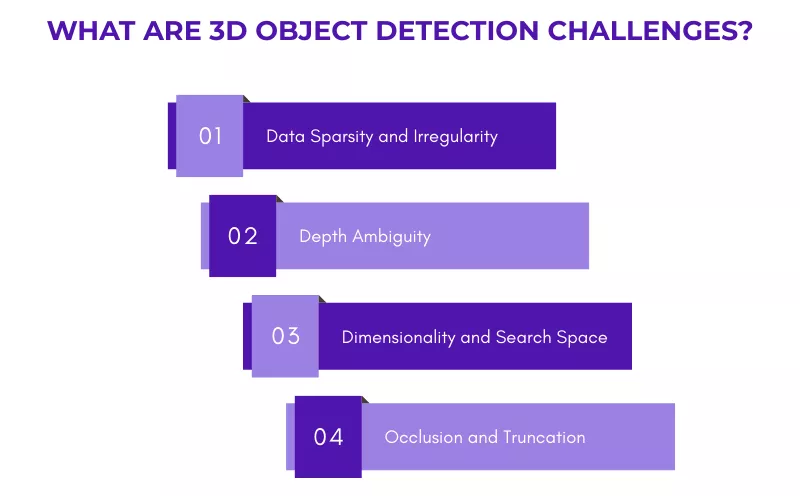
It is clear that 3D object detection is a massive upgrade both in technique and complexity when compared to 2D object detection. In this case, the understanding of the physical world’s volume, depth, and orientation from data is crucial, which is often sparse and noisy.
Let’s take you through the major 3D object detection challenges of implementing this technique:
A. Data Sparsity and Irregularity
3D data is very different from images. As objects get further away, the number of points hitting them drops significantly. For example, the system working in autonomous vehicles might struggle with distance. A nearby car can have 1000 points, while a nearby car can have only 5. The neural networks struggle to see a shape when 95% of its geometry is missing.
B. Depth Ambiguity
If you are using cameras, a stereo camera, or a monocular camera instead of LiDAR, depth estimation can be a major problem. In this case, a small object close to the lens can seem similar to a large object far away. It gets impossible to determine the Z-axis from a 2D image, as there are infinite 3D possibilities in a 2D image.
C. Dimensionality and Search Space
A 2D image has 4 degrees of freedom, whereas in a 3D object, there are at least 7 degrees of freedom, which makes the detection challenging.
D. Occlusion and Truncation
Objects constantly overlap in a crowded street. What makes it challenging is the fact that in 3D, it is not sufficient to know that something is there; it is necessary to estimate the centroid of the entire object. This is a major hurdle in 3D object detection.
That brings us to the next question of the discussion: what matters in production. Let’s take you through the answer in the following section.
What Matters in Production?
The production part is the most important part of the process. Here’s a look at what matters in production:
A. Latency (The Real Time Rule)
In production, accuracy is useless if it’s slow. To ensure that’s not the case, the object detection models must run at 10-30 FPS on edge hardware.
B. Generalization to Edge Cases
Production models must be trained to handle scenarios beyond the generalized aspects. For example, if a model is trained on the general weather of a city, it might not be able to understand things when the weather changes. Therefore, to ensure the 3D object detection is done correctly, it is necessary to train the models in every aspect.
C. Temporal Consistency
Stable detections are crucial in production. If a model sees an object in frame A, it must see the same in frame B.
D. Computational Efficiency
Developers often use Voxelization (turning points into a 3D grid) or Point Pillars (collapsing 3D points into 2D columns) to trade a bit of accuracy for massive gains in speed.
That will help you get answers to the core two questions of this discussion. During the discussion, we have talked about how 3D object detection has moved past 2D object detection and made it more detailed. However, one might wonder how the 2D and 3D object detection are different from each other. Let’s take you through the differences in the following section.
How Is 2D Object Detection Different from 3D Object Detection?
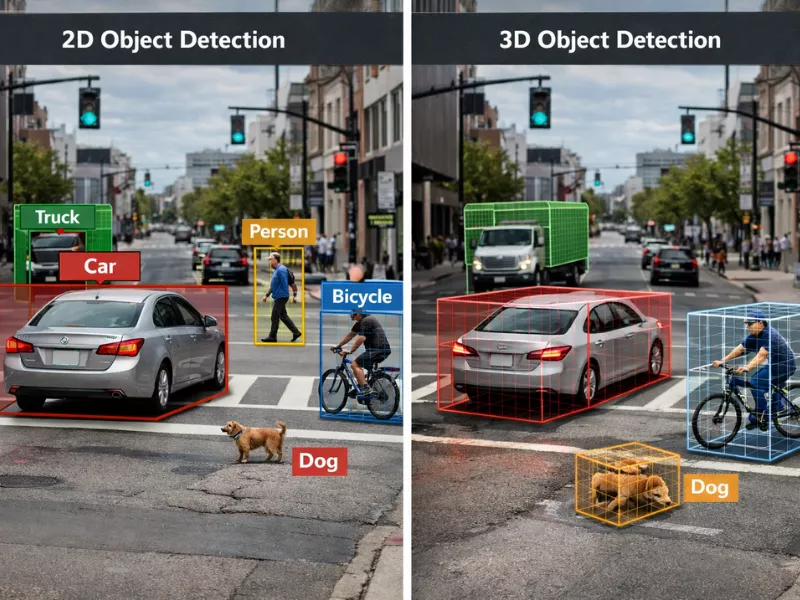
The primary difference between 2D and 3D object detection lies in the dimensionality of the spatial information captured. The following is a detailed breakdown of the differences between the two:
A. Data Representation and Output
- 2D object detection – It operates on standard RGB images (pixels). The result is a 2D bounding box defined by (x, y) coordinates, width, and height, generally represented as xmin, ymin, xmax, ymax.
- 3D object detection – It operates on 3D point clouds (from LiDAR), depth maps (from RGB-D cameras), or multiple 2D views. The result is a 3D bounding box (or cuboid) that is defined by (x,y,z) coordinates (location), dimensions (length, width, height), and rotation/heading angles (orientation).
B. Capabilities and Spatial Understanding
- 2D object detection – The method tells you what is in the picture and roughly where. However, it cannot determine the exact distance, true physical size, or orientation of the object. Also, the 2D method struggles with occlusion (objects hidden behind others) and perspective changes.
- 3D object detection – It provides precise distance (depth), exact physical size, and orientation, thus enabling a complete, accurate 3D scene understanding. The method is very good at handling occlusions and perspective, as it can see the spatial relationship between objects.
C. Sensors and Processing Needs
- 2D object detection – It uses standard RGB cameras. The algorithms are generally lighter and faster, and can often achieve real-time performance on edge devices. Examples of 2D object detection include YOLO, Faster R-CNN, and SSD.
- 3D object detection – This method needs depth-aware sensors like LiDAR, RGB-D, or stereo cameras. In sensor fusion for 3D detection production, heavy computation is necessary, which requires GPU acceleration due to large datasets. PointPillars, VoxelNet, and PointRCNN are a few of the examples.
D. Typical Applications
- 2D object detection – It is generally used for pattern recognition, photo tagging, facial recognition, content moderation, and manufacturing defect detection on flat surfaces.
- 3D object detection – 3D detection outputs are essential for autonomous driving (detecting pedestrians, vehicles, obstacles), robotics (bin picking, navigation), and AR/VR applications where spatial interaction is crucial.
While real-time 3D object detection supersedes 2D object detection, there’s a lot to know before implementing the method. The following section will take you through the advantages and disadvantages of 3D object detection.
The Advantages and Disadvantages of 3D Object Detection
Undeniably, 3D object detection provides more precise output when compared to 2D object detection. But the method has both advantages and disadvantages. Here’s a look at both of them for a better understanding:
A. The Advantages of 3D Object Detection
To begin with, this computer vision technique goes beyond traditional techniques and determines the precise location, size, and orientation of objects in a three-dimensional space. In addition to this, there are many more advantages, such as:
- Detailed spatial awareness
- Improved occlusion handling
- Environmental robustness (LiDAR)
- High precision
- Enhanced scene understanding
All these make 3D object detection models better and help computers recognize and locate objects in three-dimensional images.
B. The Disadvantages of 3D Object Detection
While there are numerous benefits of 3D object detection, there are a few limitations as well. Since it is important to understand all the aspects before implementation, here’s a look at a few of the disadvantages of the technique:
- Higher computational costs
- More complex data requirements
- Collecting and processing data
- Increased model complexity
Understandably, there are quite a few disadvantages of the technique. Yet, this is one of the best techniques to identify objects and help systems recognize and understand them. Moving on, we will take you through the applications of the technique for better clarity.
What Are the Applications of 3D Object Detection?
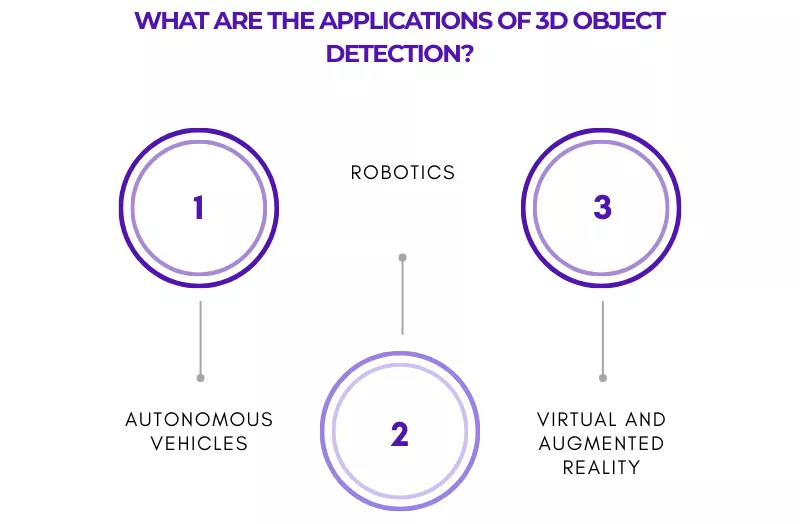
The applications of 3D object detection will help you understand how the technique is used to improve machines and help them perform better:
A. Autonomous Vehicles
This technique plays a crucial role in self-driving cars. It helps the vehicles detect pedestrians, other cars, and obstacles. Further, it provides the necessary data about their position, size, and orientation in the real world. The technique provides detailed data that helps in a much safer self-driving experience for the passengers in the car.
B. Robotics
Mobile robots and robotic arms use the technique to understand their environment, navigate, and interact with objects. The process includes picking items from shelves, avoiding obstacles, and working in dynamic, unstructured, or tight spaces.
C. Virtual and Augmented Reality
This technique is crucial for blending virtual objects in the real world. The technology is used by AR devices for scanning rooms, detecting surfaces, and placing virtual objects. This helps ensure that they interact realistically with physical objects in augmented and virtual reality applications.
This will help you understand how 3D object detection helps in improving various technologies.
Endnote:
The 3D technique has made it possible for systems to understand depth and space more effectively. It plays a major role in enabling machines understand an object’s size, distance, and position.
3D annotation tools are often used for object detection. With the development of technology, the object detection technique will continue to improve and will be adopted across various industries in the near future.
Frequently Asked Questions
What are the challenges of point cloud object detection?
The main challenges of point cloud object detection are:
- Irregular and unstructured data
- Density and sparsity issues in 3D point cloud detection
- High computational cost
- Noise and sensor imperfections
- Occlusion and partial observability
- Class imbalance and small objects
What sensors are used for 3D object detection?
The sensors that are used for 3D object detection include:
- LiDAR (uses laser pulses to measure distances to objects)
- Cameras
- Radar
- Other sensors
What is point cloud in 3D object detection?
A point cloud object detection is a raw, unordered collection of 3D data points generated by sensors like LiDAR, radar, or depth cameras.
Why are sparse point clouds hard for 3D object detection?
Sparse point clouds are challenging for 3D object detection primarily because they lack sufficient geometric structure to accurately represent objects.
How does 3D detection improve prediction over traditional 2D detection?
Compared to 2D object detection models, 3D object detection improves prediction by estimating the distance from the camera and placing volumetric bounding boxes around a detected object.
When should businesses use 3D object detection instead of 2D object detection?
Businesses should use 3D object detection when working with 3D environments, where objects within a scene need to be positioned and tracked precisely. The models trained for 3D detection improve object tracking, handle multiple objects, and analyze spatial relationships accurately. This is essential for advanced AI systems.

Want To See My Profile — Click Here Martha L. Ritter
- Synthetic Data in Computer Vision Annotation: Methods, Benefits & Applications - March 12, 2026
- 3D Object Detection: Why It’s Hard and What Matters in Production - February 17, 2026
- A Complete Vision Language Models Guide for ML Teams - February 9, 2026