Data is the most valuable element in the present world, and as technology has taken over all aspects, data annotation has become crucial. Simply put, data annotation is the process of labeling text, images, audio, or visual data to help machines understand its contents.
Data annotation has become even more critical as machine learning takes center stage in almost all spheres. The annotation process trains machine learning models to understand the data.
In this blog, we will understand machine learning data annotation, its different types, and a few practical uses.
Let’s get started!
Key Takeaways: Understanding Machine Learning Data Annotation
- Data annotation is the process of labeling data to help AI and ML models understand it
- The process is important for applications like computer vision, NLP, speech recognition, and autonomous vehicles
- The common types of annotation are image, audio, video, text, and semantic annotation
- Proper annotation helps improve model performance, reliability, and decision-making
- The major challenges include scalability, consistency, reduction in bias, and cost management
- It is important to have strong quality control and clear guidelines to make annotation projects successful
What Is Data Annotation in Machine Learning?
Computers cannot see and understand what data represents. Therefore, it is essential to train them to understand and perform better. This is where annotation comes into play.
Data annotation or data labeling is the process of adding meaningful and informative tags to a dataset to make it easy for machine learning algorithms to understand and process data.
Earlier, annotation was not as critical as it is now. Here’s why? Previously, data scientists were using structured data that did not need annotations. Now, the scenario has changed completely. Unstructured data forms a major portion of the entire global data, making annotations even more important.
Emails, social media posts, video and audio data, etc., are not structured, making annotation important. In a nutshell, annotation is a crucial step in processing data in the present world.
Moving forward, we will learn about the types of data annotation for AI and machine learning. But before that, let’s understand how the annotation process is used in machine learning.
How Is Data Annotation Used in Machine Learning?
Here’s how to annotate data in machine learning:
- Step 1: Data collection
- Step 2: Preprocessing
- Step 3: Defining guidelines
- Step 4: Annotation
- Step 5: Quality control
- Step 6: Feedback
- Step 7: Final review
The annotation task is a long one and must be supervised by experts. Companies offering data annotation services have experts who are well-versed in the annotation techniques and ensure accurate annotation.
Ensuring the annotation is done correctly is important for the machine learning models to perform well. Accurate annotation can help machine learning models to generalize patterns, thus improving adaptability and reliability across different real-world scenarios.
Now that you understand how data annotation is used in machine learning, let’s move on and learn the different types.
What Are the Different Types of Data Annotation?
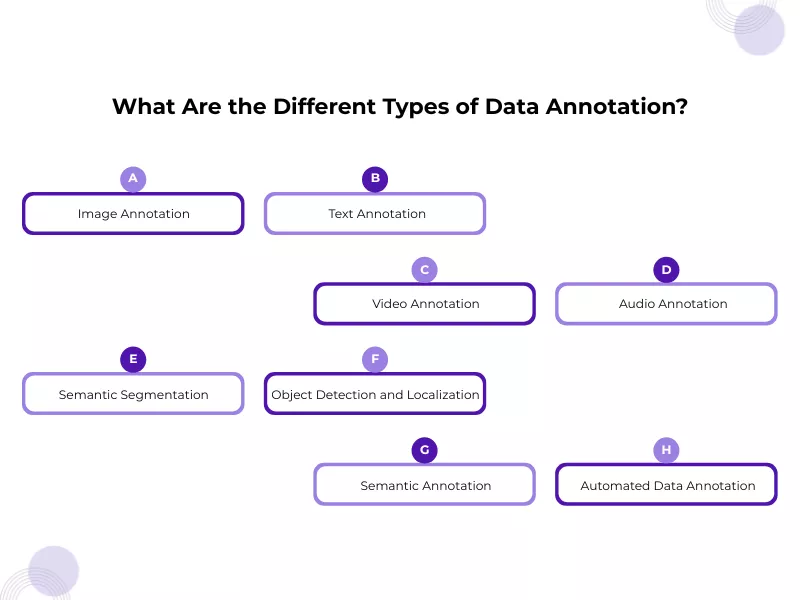
There are different types of data annotation for AI and machine learning. Let’s go through them one by one to understand why they are important for machine learning (ML) and artificial intelligence:
A. Image Annotation
Image annotation involves identifying and labeling visual elements in an image. Its best uses are facial recognition technology in mobile devices and product categorization in e-commerce.
B. Text Annotation
Machines need to understand each word that is entered. For example, if you entered a search query like ‘the best machine learning and image annotation experts.’ In this case, the machine will show accurate results if it understands your query. Text annotation comes into play in this case. It helps identify entities, keywords, or sentiments within the text, thus helping machines understand your search query.
C. Video Annotation
Video annotation is used for traffic monitoring, sports analytics, and other aspects. It follows the principle of image annotation and applies it to moving footage, thus enabling machines to understand the different objects in a video.
D. Audio Annotation
Voice and speech recognition are two of the most used technologies in the present world. The process that makes the machine understand your voice is called audio annotation. It is one of the important types of machine learning data annotation.
E. Semantic Segmentation
Semantic segmentation is a sophisticated form of image annotation. In this case, an image is segmented into parts to ensure a detailed understanding of each. Automatic cars use this technology to distinguish between people, traffic signs, pavement, and other vehicles on the road.
F. Object Detection and Localization
Functions like tracking inventory in a retail shop or finding a book in a library require proper and specific identification of a product or book. Object detection and localization are the processes of identifying and locating different objects in an image.
G. Semantic Annotation
Semantic annotation refers to adding metadata to a text to help machine learning algorithms. The raw data is processed to understand how one term relates to another or to differentiate one element from another.
H. Automated Data Annotation
Automated annotation refers to annotations using annotation tools. The tools are used to annotate data for better and faster machine learning models. In these cases, supervised learning annotation or manual annotation is not necessary. However, a quality check must be done to ensure those are accurate.
These are the main types of data annotation or data labeling in modern AI and ML projects. All these make it easier for machines to understand data and share accurate results.
Why Is Data Annotation Important for Machine Learning Models?
Data annotation is crucial for machine learning training data. Machines need to deliver accurate results. Different annotation techniques aim to help machines learn and understand new and unseen data. An effective annotation process enables machines to understand what a text, audio, video, or image entails.
The entire process is essential to making machine learning models more trustworthy. Today, when everyone relies mostly on technology to find answers to their questions or to facilitate their daily activities, annotation in machine learning is considered very important.
For example, if you have searched for ‘the future of e-commerce annotation’ on the web, you will expect statistics on the topic to understand the industry. The results shown answer the question since the machine is familiar with all the words in the search query. This is possible because data annotation was done correctly.
What Are the Best Practices for Running Machine Learning Data Annotation Projects
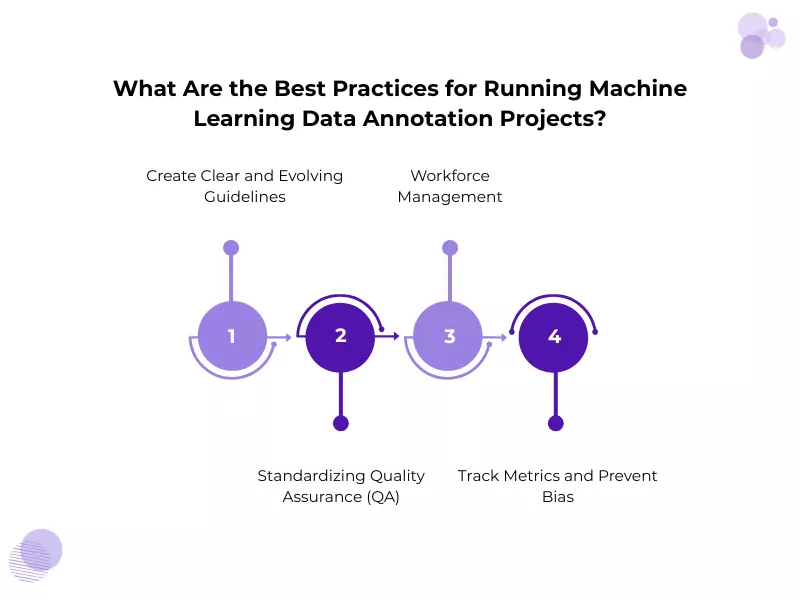
A successful machine learning data annotation project needs clear guidelines, proper quality control, and the combination of human annotators and tools. The following are a few best practices that most well-known data annotation companies follow:
A. Create Clear and Evolving Guidelines
The first step is to create a set of highly detailed instructions defining every label, category, and the expected output.
Adding on, it is necessary to provide both clear-cut and negative examples for visual tasks. It is equally important for the annotators to treat the guidelines as a working document and keep updating them continuously to avoid and adapt to edge cases.
B. Standardizing Quality Assurance (QA)
Quality assurance is one of the crucial elements of the entire data annotation process. The best data annotation companies start with labeling a small, varied batch to reveal misunderstandings in the rules before working on the final dataset.
Adding on, it is essential to implement multiple review steps. Once an annotator labels the data, a senior annotator reviews the labeling before delivering the final output. In case of annotation using automated tools, the project is reviewed by a human to identify misses and fix them before the final delivery.
C. Workforce Management
Companies offering data annotation services for machine learning must invest in training annotators. It is wrong to assume that annotators are well-versed in the domain. The companies must invest time to train them and keep them updated with the changing rules and regulations.
Establishing clear and quick feedback systems to enable annotators to ask questions and clarify their doubts on edge cases immediately. In the case of specialized domains, it is necessary to assign domain experts to prevent costly mistakes.
D. Track Metrics and Prevent Bias
An effective way to keep quality under control is to track quantitative metrics, such as precision, recall, and word error rates, and monitor them continuously. Also, it is important to ensure that you have a diverse annotator pool and that the instructions account for minority groups to prevent encoding unfairness and bias in demography.
Companies need to maintain a proper workflow. You need to treat data preparation as an important process. Review the model performance continuously and adjust the strategy to ensure the flaws are corrected early.
What Are the Challenges in Data Annotation?
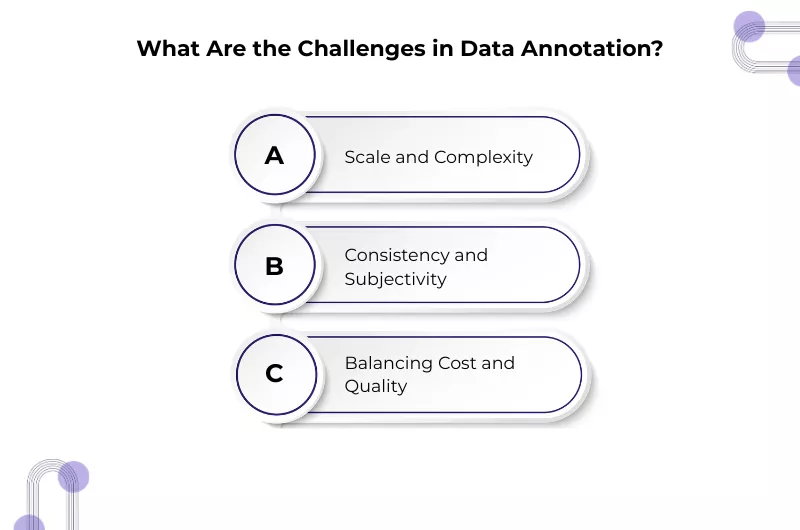
Machine learning data annotation is essential. While the process seems great, it has a few challenges. Understanding these challenges is crucial for a better understanding of machine learning technologies or AI.
A. Scale and Complexity
One significant challenge in data annotation is managing the massive volume of data required to train machine learning models. With technology evolving rapidly, the need to annotate data has become even more important. However, since we expect technology to do more than it used to, it is necessary to annotate large datasets. It is challenging to annotate large and complex data to keep up with the trends.
B. Consistency and Subjectivity
Data annotation involves different data types. The challenge is to annotate data that requires understanding specific elements within an image. It is not possible for one annotator to annotate all data. Different annotators might have different perspectives on a similar image, leading to inconsistencies. This affects the overall machine learning algorithm and the entire process.
C. Balancing Cost and Quality
Annotation can be costly, considering the accuracy required. Manual annotations can be too expensive, while automated annotations can be cost-effective. However, when it comes to accuracy, companies need a combination of both. Organizations have a tough time finding the right balance between cost and quality, which is one of the major challenges in annotation.
Knowing how you get the correct data when you search online and how annotation plays a major role is crucial. The process is also applied to understanding medical images. Medical data annotation in machine learning is playing a major role in improving the healthcare industry. In a nutshell, annotation has proved to be one of the important processes for helping machines learn and understand different data.
What Is the Difference between Data Annotation and Data Labeling?
We have used data labeling and data annotation interchangeably in the discussion. However, there’s a difference between the two.
The primary difference is that data labeling simply categorizes raw data with a tag, answering ‘what is this,’ and data annotation goes deeper, adding detailed context, relationships, and metadata to help machines understand ‘what,’ ‘where,’ and ‘how’ of a dataset.
Here’s a look at the key differences between the two:
| Feature | Data Labeling | Data Annotation |
| Depth | Basic categorization | Context-rich descriptions, shapes, or tags |
| Effort | Fast, high-volume | Slower, requires deep scrutiny |
| Worforce | Generalists | Subject-matter experts |
| AI Goal | Classification | Object detection, boundary mapping, reasoning |
The choice of method relies on two things:
- What type of data are you working with?
- What is the end goal of the AI model?
That said, it is equally important to understand whether to keep the process in-house or outsource the project. The following section will take you through the differences to help you make an informed decision.
In-House vs. Outsourcing Annotation: Which Do Companies Prefer?
The decision depends on several factors. Companies consider cost, flexibility, and various other factors to make an informed decision.
A. In-House Annotation
Highly regulated industries often prefer in-house annotation. However, the process is costly. Not only do the companies pay huge salaries to annotators, but they also have to invest in specialized tools for high-quality annotations.
B. Outsourced Annotation
This is preferred by most companies. It is effective to deal with high-volume, spiky, or recurring workloads that would need rapid turnaround. The reason companies prefer this method is that it eliminates heavy upfront infrastructure, recruitment, and hardware costs. In this case, the companies pay only for output. Companies must understand the reasons to outsource data annotation projects and find the right service provider to get accurate results.
Who Uses Annotated Data in Machine Learning?
The machine learning annotation process is used by numerous industries. Here’s a look at a few of them for your understanding:
A. Manufacturing
Manufacturers often use annotations to identify and label errors in product images to help the AI models recognize the flaws. As a consequence, it allows models to detect defects and misalignments during production. It helps ensure that customers get only quality products.
B. Finance
Text annotation is commonly used in finance firms for analyzing large data sets of financial text, training the model to identify fraud, risk assessment, and ensuring that the documents are compliant with regulations.
C. Legal
Proper annotation helps ML models summarize law cases, understand and analyze contracts, perform legal research, and ease online discovery.
D. Retail
Businesses use annotation to train ML models to understand the preferences of customers, for inventory management, and for store layout improvement. Also, the annotation can help develop AI-based voice assistants to assist customers with questions and product recommendations.
What Is Reinforcement Learning from Human Feedback?
When it comes to machine learning data annotation, it is crucial to understand the concept of Reinforcement Learning from Human Feedback (RLHF). This is a machine learning technique used to align AI models, particularly Large Language Models, with human intentions and preferences.
The technique teaches the models to produce helpful, harmless, and contextually accurate responses with respect to human judgment, instead of simply generating text.
Annotation Box: The Best Place to Get Accurate Data Annotation
We at Annotation Box have the best resources and the finest experts to help you with accurate annotations. Our human-in-the-loop workforce is considered the industry’s finest for providing high-quality labeled data for machine learning models.
We cater to different industries and have the necessary experience to annotate data of different categories. You can count on us when you need your data annotated. We have 6+ years of experience annotating data and can be the best for accurate annotations.
Frequently Asked Questions
How do you validate data annotations?
The right ways to validate annotations include proper manual review of annotations. There are two ways the validation process works:
- Full review (100%) – Each annotation is checked by a reviewer before it is accepted
- Sampling-based review – Only a part of the annotation is reviewed
Why is it important to remove bias in data annotation?
Biases in annotation can hamper the results, resulting in inconsistencies and inaccurate results. Human intervention is crucial to ensure the accuracy and quality of annotations and remove bias and ambiguities.
What are a few real-world applications of data annotation?
Real-world applications of annotation include:
- Self-driving cars
- Image search engines
- Speech recognition
- Natural language processing
What types of data can be annotated?
Various types of data can be annotated for computer vision and ML models. These include:
- Image
- Text
- Video
- Audio
- Sensor and LiDAR annotation
Can you handle large-scale datasets for ML training?
Yes, we can handle large-scale datasets for ML training. We use a human-in-the-loop process to handle these datasets and deliver accurate results.

Want To See My Profile — Click Here Shrey Agarwal
- Machine Learning Data Annotation: A Comprehensive Guide - June 5, 2026
- How to Create Data Labeling Specifications for an Annotation Project? - April 14, 2026
- Financial Data Annotation: A Complete Guide for Banking and Finance - January 12, 2026