Image annotation is the process of labeling parts of an image to help AI understand and interpret visual data. These labels transform raw images into meaningful datasets that artificial intelligence (AI) systems use to learn how to recognize and classify objects in new images.
Think of annotated data as an answer key for machine learning. During training, AI compares its predictions to the labeled data, learns from mistakes, and gradually improves its performance. This process is essential in a wide range of real-world applications—from detecting diseases in medical scans to identifying road signs and pedestrians in self-driving cars, and powering accurate product searches in e-commerce. This blog shows all aspects that show how Image Annotation Improves AI Model Accuracy.

Image annotation improves AI model accuracy by providing clear, consistent, and high-quality training data. Well-annotated images help models learn more effectively, reduce prediction errors, and limit the need for repeated retraining—ultimately saving time and reducing development costs.
In simple terms, image annotation is the backbone of computer vision. Without it, AI wouldn’t be able to see or make sense of the visual world. It’s what turns raw visual input into smart, actionable insights that drive the AI technologies we rely on every day.
Powering AI Systems with Training Data
- The AI development lies in data annotation. Here, experts annotate images to build reliable datasets.
- High-quality training data enables machine learning algorithms to learn in an effective manner.
- In addition, this helps AI systems and training models achieve greater accuracy in the real world.
The most advanced AI will struggle to interpret visual data without image annotation techniques and precise annotation tasks.
Techniques for Accurate Annotations
- Various annotation techniques help machines recognize objects.
- Professional annotators get support from modern annotation tools.
Furthermore, ensures the annotation quality while working with complex images. Accurate labels influence AI model training and model performance.
Improves AI Model Performance
- An accurate annotation process ensures AI models receive the right input and it helps AI to learn and adapt.
- Also, well-labeled data plays a vital role in training AI for many industries.
Building Reliable Artificial Intelligence
- The AI Performance gets strengthened with the help of professional image annotation.
- Besides, accurate image annotation reduces errors and bias.
- Image annotation is crucial for training models.
- It helps them to classify and detect.
- They can also predict outcomes effectively.
Hence, Data Labeling Services gives you high-quality data annotation.
Common Challenges in Image Annotation for AI Projects While Maintaining Accuracy

Ambiguity in Object Boundaries
In image annotation for AI, one big challenge is ambiguity in object boundaries. In other words, it’s often hard to clearly see where one object ends and another begins.
What is the problem?
Imagine you are asked to draw lines around every object in a picture so that a computer can learn what those objects are. That’s what image annotation is. But sometimes:
- Objects are too close together
- They overlap each other
- They blend into the background
- The edges are not clear (blurry or textured)
In such cases, even annotators may struggle to agree on where the exact boundary is. So how can we expect a computer to learn it perfectly?
Why does this matter?
- If the annotation isn’t accurate, the AI will learn from confusing or incorrect data.
- The model may then misidentify objects in real-life images.
- This lowers the accuracy and performance of AI systems, especially in fields like self-driving cars, medical imaging, and surveillance.
Example
Think about a photo of a dog lying on a brown carpet. The dog’s fur is similar in color to the carpet. It’s tough to draw a perfect line between the two. This unclear separation is boundary ambiguity.
How it affects AI
- AI might learn that the carpet is part of the dog.
- In real-world use, it might fail to detect dogs correctly.
Subjectivity in Labeling
One of the biggest challenges in image annotation is subjectivity in labeling. This happens when different people see the same image but label it in different ways.
What is Subjectivity in Labeling?
In simple terms:
- Humans don’t always agree.
- One person might label a blurry object as a “cat,” while another calls it a “dog.”
- Even trained annotators might see things differently.
This human judgment leads to inconsistencies in the AI training data annotation, which affects how well AI models learn.
Why Does It Matter?
In computer vision and image annotation, AI learns from annotated datasets. If those labels are inconsistent or unclear, the model gets confused.
Even high-quality image annotation services can struggle when the task is open to interpretation. For example, where should the boundary of a shadow end? Is something “partially visible” still labeled fully?
Even high-quality image annotation services also fail here.
Scalability Problem
Image annotation techniques are a key step in training AI and computer vision models. But when datasets grow into thousands or millions of images, scalability becomes a major challenge.
Manual image annotation takes a lot of time and effort. Annotators must label every object in every image; this becomes slow and expensive as the dataset grows.
For example:
- Labeling 500 images might take a few hours
- Labeling 5 million images manually could take months or even years
This makes it hard to keep up with the demand for high-quality AI training data annotation.
Ensuring Consistency Across the Image Annotation Process
In the world of image annotation for AI, one of the biggest challenges is making sure all the labels are accurate and consistent. This may sound simple, but it’s actually quite difficult — especially when dealing with large datasets.
What Makes It Challenging?
Different People, Different Judgments
- Annotators may label the same image differently.
- For example, where one person sees a “small car,” another might just label it “vehicle.”
- This inconsistency confuses the AI model during training.
Complex or Blurry Images
- Images with overlapping objects, shadows, or poor lighting make it hard to draw clear boundaries.
- This affects image labeling for deep learning and reduces data quality.
Multiple Annotation Types
- Using various image annotation types (like bounding boxes, polygons, or segmentation) increases complexity.
- Each type needs a different level of detail and accuracy.
Lack of Standard Guidelines
- Without clear instructions, annotators may interpret objects in different ways.
- This leads to inconsistent AI training data annotation.
Human Error
- Manual annotation is time-consuming and prone to mistakes, especially at scale.
- Even a small error in one image can mislead the model.
Handling Complex Visual Scenes in the Annotation Tools
In image annotation, one of the biggest challenges is dealing with complex visual scenes — images that have many objects, overlapping elements, or unusual conditions like poor lighting or cluttered backgrounds.
Why Are Complex Images Hard to Annotate?
When an image contains:
- Multiple objects close together
- Small or partially hidden items
- Shadows, reflections, or motion blur
Hence, it becomes difficult to label each object correctly. Even the best image annotation tools or professional image annotation services can struggle with these types of images.
The Problem for AI Training
Image annotation is vital for training AI models. If the annotation is not done properly, the AI training data annotation becomes unclear or inaccurate. This leads to:
- Confused AI models
- Poor object detection
- Lower accuracy in real-world use
AI and machine learning systems rely on precise image annotation to learn how to recognize and understand objects. If the data is messy, the model’s performance drops. Image annotation for Retail and e-Commerce is also needed.
The Future of Image Annotation: Boosting AI Model Accuracy with Advanced Techniques
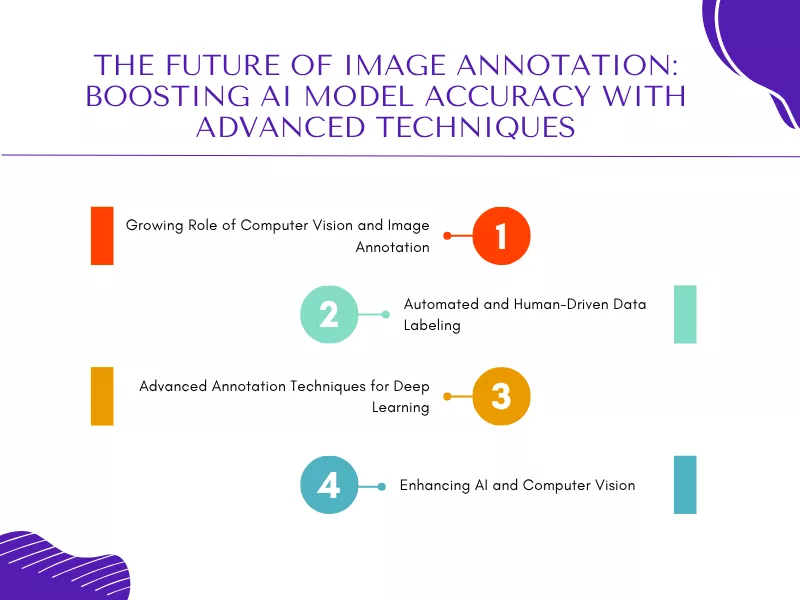
Growing Role of Computer Vision and Image Annotation
- The future of computer vision and image annotation is driving how AI models are trained to improve accuracy.
- Advanced types of image annotation help to create rich annotated datasets and form the foundation of AI training data annotation.
Furthermore, making it easy for models to recognize objects. These objects can operate reliably in diverse conditions.
Automated and Human-Driven Data Labeling
- The automated data labeling for AI models is mixed with human expertise.
- This hybrid technique makes sure that data labeling for AI models is fast.
- It also helps in maintaining the quality of annotations.
- In addition, using image annotation becomes more efficient when combined with automation and human review.
- It helps in delivering scalable solutions to meet the demand for high-quality datasets.
This balance allows image annotation to help address accuracy gaps and create trustworthy training data.
Advanced Annotation Techniques for Deep Learning
New methods have been launched, such as
- 3D labeling.
- Real-time annotation.
These are revolutionizing AI and computer vision systems. In addition, these help AI to learn from difficult visual environments. Additionally, it is going beyond simple 2D inputs. The result is more accurate.
Enhancing AI and Computer Vision
- One more future trend is combining AI training data annotation with data augmentation methods.
- The diversification of training samples ensures that industries can reduce bias. Industries can also build stronger computer vision and image annotation processes.
Furthermore, precisely annotated datasets for AI are essential for training computer vision applications.
Choosing the Right Image Annotation Services: The AnnotationBox Advantages
Role of Professional Annotation Services
High-Quality Labels
The professional services will ensure that the correct taglines and labels are used in the images. It will help you model to identify in a correct manner.
Different Annotation Methods
Different types of image annotation are used by professionals. Each method fits a different AI task like object detection, medical imaging, or autonomous driving.
Accuracy and Consistency
They also follow strict guidelines and review each other’s work. This consistency ensures that you get a clear and reliable data set. The AI model requires proper annotation to achieve improved accuracy.
Scalability
Businesses often need thousands or even millions of labeled images. The image annotation provides you with a service to manage it. They will manage large volumes quickly without losing quality.
Proper AI Model Training
Get proper annotations that are more detailed and suited for specific AI use cases. You will get precise AI services for your image annotation.
Data Security and Automated Annotation Tools
Human annotation ensures accuracy and efficiency. In addition, AI applications helps to keep your data safe and meet privacy standards. They also deliver in formats that fit directly into AI training pipelines.
Frequently Asked Questions
Why is image annotation important?
Image annotation labels images. It further creates the training data needed to teach computer vision models. The models wouldn’t know what they’re “looking at,” without annotated data. In addition, it is making it impossible for them to perform tasks like object detection or image classification. With this, the machines have the ability to “see” and understand the world in the same way humans do.
What are the four benefits of annotation?
Key benefits are provided by image annotation :
- Improved Model Accuracy: High-quality labeled leads to a more precise AI model. This helps it to learn from the ground truth provided by the annotation.
- Enhanced Performance: Annotated datasets with diverse examples of objects, scenes, and conditions allow a model to generalize better and perform properly.
- Real-World Applications: Annotation enables a wide range of practical applications. You can say that annotated satellite imagery helps in urban planning.
- Creating Ground Truth Data: Annotation generates a correct answer that the AI model learn from. It is essential for measuring the model’s effectiveness and ensuring it makes correct predictions.
What are the skills of image annotation?
Several key skills are vital for a successful image annotator:
- Attention to Detail: You must be careful, as small mistakes can create inaccurate training data and negatively impact the AI model’s performance.
- Strong Visual Perception: You must know how to identify and differentiate objects, shapes, and features in images. This will help you with efficient and accurate labeling.
- Basic Technical Proficiency: Be comfortable using computer software and annotation tools like bounding boxes, polygons, and key points. Having computer skills is vital.
- Critical Thinking: You must make judgments based on context and project guidelines.
What are the three purposes of annotations?
The main purposes of annotation are all centered on making data usable for machine learning.
- To Train Machine Learning Models: Thennotation creates the labeled datasets that are fed into supervised learning models. It is teaching them to identify and understand patterns in visual data.
- To Establish Ground Truth: The “correct answers” is given by the annotation. From there, a model learns from and is tested against.
- To enable AI to “See” and interpret: Humans can easily recognize objects, and annotation bridges the gap between human understanding and machine learning. It translates visual information into a structured, labeled format that machines can interpret and process.
What are the best practices for image annotation?
These are the best practices to ensure high-quality and reliable annotations
- Create a proper instruction for annotators. Investing in high-quality image annotation helps maintain consistency, especially when multiple people work on the same project.
- Annotators must use the same labelling style in the entire dataset.
- Do not forget to label every instance of the target objects.

Want To See My Profile — Click Here Ankit Sureka
- How Image Annotation Improves AI Model Accuracy and the Role of AI Model Training? - October 20, 2025
- Types of Data Classification and How They Protect Sensitive Information - September 18, 2025
- The Impact of High-Quality Image Annotation on Facial Recognition AI - July 21, 2025