Modern farming faces many challenges, including feeding a growing global population while minimizing environmental impact and maximizing efficiency. A recent market research report found that the global precision agriculture market will grow to 11.38 billion in 2025 and is expected to be 21.45 billion in the year 2032. This further growth is fuelled by the dire necessity to sustainably farm produce. This is just one of the ways that this technique has cropped up with semantic segmentation that assists in crop management AI in combination with satellite imagery, crop monitoring, and drone systems, and has allowed farmers to more easily monitor, analyze, and manage their crops while remaining sustainable.
Key Takeaways
- Precision agriculture combines technology with agronomic expertise
- Semantic segmentation enables pixel-level crop analysis
- The precision agriculture market is experiencing great growth
- Predictive capabilities are advancing with precision agriculture, helping farmers forecast yields, disease outbreaks, and optimal management decisions.
Understanding Precision Agriculture and Its Core Technologies
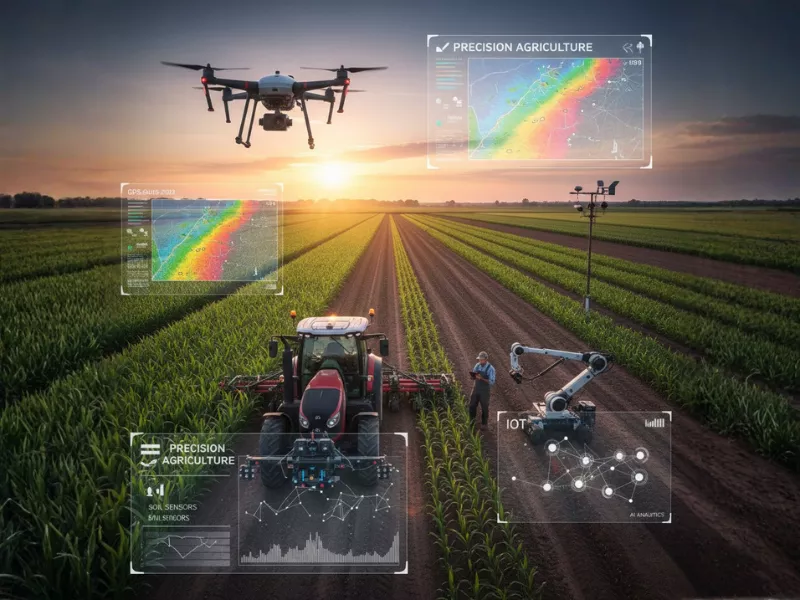
Precision agriculture is defined as a farm management strategy that uses technology to observe, measure, and respond to variability within agricultural fields. The success of precision agriculture depends on AI data annotation services that provide the foundation for training machine learning models. Precision agriculture recognizes that soil types, drainage patterns, pest pressure, and growing conditions vary across space and time, which allows farmers to manage this variability by applying inputs like water, fertilizer, and pesticides precisely where and when needed.
What Makes Precision Agriculture Different from Traditional Farming?
| Aspect | Traditional Farming | Precision Agriculture |
|---|---|---|
| Application Method | Uniform across the entire field | Variable rate based on specific zones |
| Data Collection | Manual observation, limited sampling | Continuous monitoring, via sensors, drones, and satellites |
| Decision Making | Experience-based- reactive | Data-driven, predictive |
| Input Efficiency | Often over-application | Optimized application, reducing waste |
| Environmental Impact | Higher chemical runoff | Minimized through targeted application |
| Cost Structure | Fixed costs regardless of the field's variability | Optimized costs through precise resource allocation |
The technologies of Precision Agriculture change this in three fundamental ways. First of all, it changes to proactive management. Traditional agriculture is an action taken upon the realization of the problems, whereas precision agriculture allows taking action in advance because of the early signs of the problem and predictive models.
Second, precision agriculture transforms into variable management. The traditional farming mode uses the uniformity of the rates across the whole field or the vast area of management. Precision agriculture knows that there are enormous differences in field averages.
Third, it converts subjective decision-making into objective decision-making. Even though experience in the field remains relevant, accuracy in agriculture enhances human knowledge with data analytics.
Key Technologies Used in Precision Agriculture
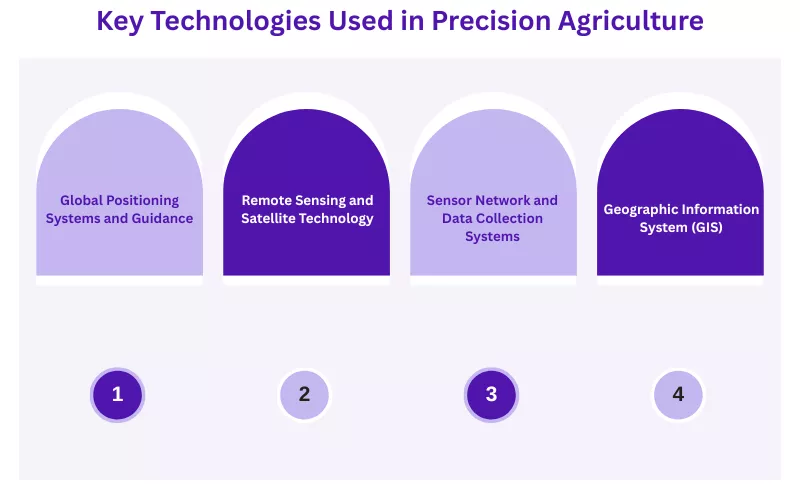
The precision farming ecosystem comprises several interconnected technology categories that work together to collect data, analyze conditions, and enable site-specific, precise management. Image Annotation in Agriculture forms the foundation of training AI models for crop analysis. The technology includes:
Global Positioning Systems and Guidance
All precision agriculture is based on GPS technology since it provides the spatial framework. GPS receivers on harvesters, sprayers, and tractors have centimetre-precise accuracy that captures the precise position of the equipment when it passes through the field.
The positioning information allows yield mapping, guidance systems that control equipment to follow specific paths, and variable rate control, which varies the rate of input according to location.
Current GPS has a precision of 2-3 cm, which means that the equipment would be able to navigate along the same paths every year and thus, minimize soil compaction and maximize field productivity.
Remote Sensing and Satellite Technology
Satellite imagery crop monitoring analysis provides regular field monitoring at 3-10 meter resolution through platforms like Sentinel-2 and Landsat.
While coarser than drone imagery, satellites offer frequent revisit, enabling continuous crop monitoring throughout the growing season. Satellites capture multispectral data revealing crop health through vegetation indices like NDVI, which indicates plant vigor and stress levels.
Sensor Network and Data Collection Systems
Another important element is represented by ground-based sensors. Soil sensors monitor moisture, temperature, electrical conductivity, and the availability of nutrients at various levels. The data is sent wirelessly to farm management systems and delivered in real-time, meaning that the farm management is able to make irrigation and fertilization decisions based on the data.
In farms, weather stations are used to gather information on temperature, humidity, rainfall, wind speed, and solar radiation, among others.
Geographic Information System (GIS)
A geographical information system is used by the farmers to create, store, and analyze site-specific crop management. It is also used to monitor agricultural production, crop type, soil samples, etc. This data analysis uses a precision agriculture system to input, display in map-like form the crop yield.
What Is the Role of Semantic Segmentation in Modern Agriculture?
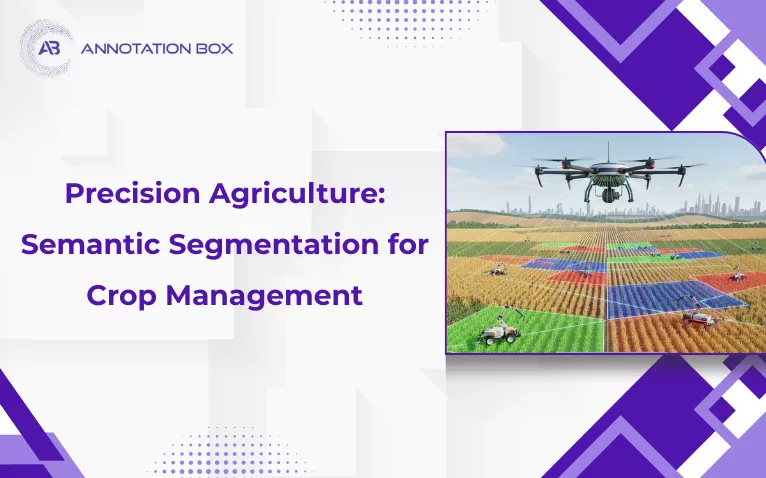
Semantic segmentation in agriculture serves as a boon in computer vision technology, allowing pixel-level classification of images. This means every pixel in a drone or satellite image can be categorized, whether it represents healthy crop development, stressed vegetation, bare soil, weeds, or water.
Image segmentation in computer vision has grown greatly, with deep learning models like U-Net, DeepLab, and SegNet now achieving remarkable accuracy in agricultural applications. These models analyze imagery captured from various sources and create detailed segmentation maps that reveal field conditions with clarity.
What Are the Benefits of Precision Farming?
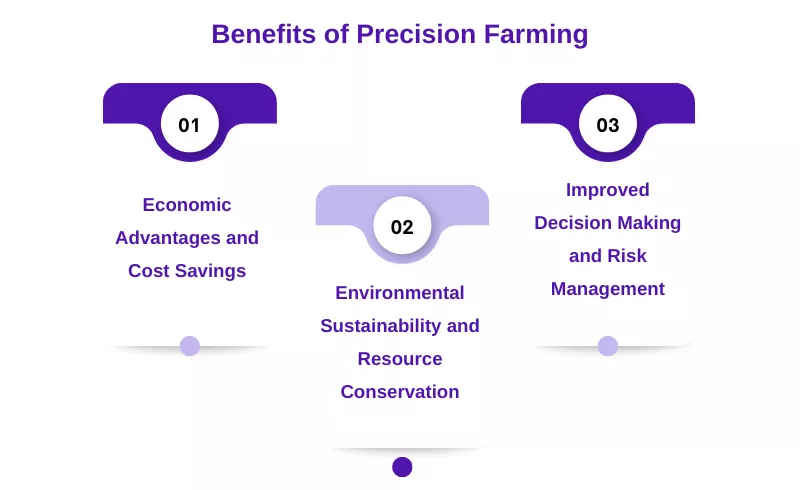
The adoption of precision agriculture presents various benefits, which are not only confined to the productivity of a specific farm but also to the wider environmental and economic sustainability issues. All of these advantages of precision agriculture are becoming necessary to contemporary farming activities of any scale.
Economic Advantages and Cost Savings
Precision farming is the method to use in search of cost reduction and environmental friendliness in crop production. The utilization of precision technologies minimizes the expenditure without compromising or increasing the crop yields. Precision irrigation or precision agricultural tools cut down on the costs of fertilizers on farms by 15-20 percent. Advanced analytics are now affordable with the best precision agriculture software for small farms because it offers these features via affordable cloud-based subscriptions and does not require huge investments in IT infrastructure.
Environmental Sustainability and Resource Conservation
The most sustainable approach is to use precision agriculture for environmental benefits. Precision agriculture will minimize the chemicals used in agriculture, the amount of fertilizer, and this means that nutrient runoff into the waterways and greenhouse gases generated during fertilizer production will be reduced. The techniques of precision agriculture are effective in the maintenance of the health of the soil by applying technologies, like GPS guidance, which contribute to the protection of most parts of the field area and to confining the compaction to certain areas.
Improved Decision Making and Risk Management
Precision agriculture assists in converting educated guesses to data-driven choices in making good management decisions. The multi-year data are used to determine the performance of different varieties of crops according to different weather conditions or when they are planted or fertilized. Precision agriculture enables risk mitigation because it knows the methods that are reliable and does not focus on strategies that have failed before. The risk management is further promoted through predictive capabilities through disease forecasting models.
Precision Agriculture and Predictive Farming: The Future of Crop Management
The evolution of precision agriculture has reached the next stage of reactive monitoring, being substituted by proactive prediction. Predictive farming uses the results of semantic segmentation and machine learning models, weather predictions, past data, and agronomic expertise to forecast the future state of the field and make the best decisions to manage it before issues occur. Applications of predictive control have been in yield control, prediction of disease outbreaks, optimization of irrigation, and nutrient management.
The machine learning models powering predictions are:
- Time series forecasting
- Random forest ensembles
- Deep learning LSTM
- Bayesian Networks
- Crop Simulation Models
How to Implement Precision Agriculture on Small Farms?
Many farmers believe precision agriculture requires massive capital investment suitable only for large operations. However, understanding how to implement precision agriculture on small farms reveals that implementation can be scaled to farm size and budget, with soil sensors for precision agriculture costing varying from a few hundred dollars for basic systems to several thousand for comprehensive networks.
Practical Steps for Getting Started
- Assessment and Planning: Evaluate current farming practices and identify pain points. Research available technologies and their compatibility with existing equipment, then start with one field or crop type as a pilot program.
- Basic Technology Adoption: Implement the best precision software for small farms, like GPS guidance systems for accurate field operations, establish baseline soil testing across field zones, and then consider drone services or satellite monitoring subscriptions.
- Advanced Integration: Integrate data streams into farm management software, implement variable rate applications based on collected data, and then analyze first season results and refine approach.
Adopting Precision Agriculture Through Digital Farm Management
The change to precision farming requires acquiring sensors and precision agriculture drones for crop monitoring. It needs complete digitalization of farm operations. Digital farm management systems then integrate the data from various sources and provide analytical tools for decision support that make precision ag technologies effective while practising. You can do that by:
Building Digital Infrastructure for Modern Farms
Digital farm management needs a large amount of data infrastructure to begin with. It includes the installation of GPS guidance on the equipment, the positioning of the soil sensors on the fields, satellite images, surveying crops, and arranging drone flights or contracting the service providers. It is technological innovation in the agricultural sector, which must be incorporated into a single unit where human hands are not required to transfer information, but information will automatically transfer between platforms.
From Data to Actionable Insights
The process of collecting data that is to be used in agriculture is not the end. The value is based on the conversion of raw data into actionable insights. In the context of farm management platforms, analytical tools can process the data in order to detect patterns, make recommendations, and justify decisions. Precision agriculture uses:
- Spatial Analysis and Mapping.
- Trend Analysis and Temporal Analysis.
- Predictive Modeling
- Economic Analysis
Challenges and Future Directions
Despite tremendous progress, semantic segmentation in agriculture faces several ongoing challenges that researchers and developers continue to address.
Current Limitations
- Weather Dependency: Cloud cover prevents optical satellite and drone imagery collection, creating gaps in monitoring. Synthetic Aperture Radar (SAR) provides weather-independent alternatives but requires different segmentation approaches.
- Computational Requirement: Processing high-resolution imagery across large farm areas demands significant computing power, limiting real-time applications for some farmers.
- Model Generalization: These models trained on one crop type, growth stage, or geographic region often perform poorly when applied to different conditions. Transfer learning and domain adaptation techniques help, but don’t fully solve this challenge.
Emerging Innovations
The future of semantic segmentation in agriculture includes several exciting developments:
- Multimodal Fusion: It will combine optical imagery with thermal, hyperspectral, LiDAR, and SAR data, which provides richer information than any single sensor. Advanced fusion algorithms extract complementary information from each modality.
- Temporal Segmentation: It will not just analyze single images, but rather it will use temporal models that need to process time series to understand crop development trajectories and detect anomalies earlier.
- Digital Twin Integration: Semantic segmentation feeds digital farm models that simulate crop responses to management decisions, enabling “what if” scenario analysis before implementing changes.
Conclusion
Embracing precision agriculture implies that one is not confined to large commercial enterprises. The core of this revolution is semantic segmentation, which converts crude imagery to finer information that drives all the activities involved in crop management.
Precision agriculture technologies based on semantic segmentation can be used in large-scale operations (thousands of acres) or small-scale specialty crop operations to enhance the efficiency, sustainability, and resilience of your operation in a challenging agricultural environment.
Frequently Asked Questions
How do you annotate images in semantic segmentation in agriculture?
It begins with scoping and taxonomy development, platform selection, training of the team, labeling of pixels on a pixel-level, quality checks, expert checking, and provision of the final data to the training models.
What is the method of constructing a dataset using drone images?
Record RGB or multispectral drone imagery at different stages of crop growth, which is spatially and temporally diverse to meet the needs of diverse terrains. Denoise, crop, and downsample with a uniform number of points before annotating with classes such as crops and weeds. Apply 3D instruments on multi-view pictures or point cloud instruments, such as scanners.
What is the difference between semantic segmentation and instance or panoptic segmentation during crop management?
Semantic segmentation assigns semantic labels to pixels based on category (e.g., crop vs. weed) without differentiating between different instances; instance counts every object, whereas panoptic counts both to gain a full picture of the scene.
How much do you charge for data annotation?
Pricing is tailored to the needs of the project, such as the complexity of annotation, volume of data, and deadline.
Does it offer long-term/large project discounts?
Yes, long-term projects have subscription discounts. Short-term and on-demand projects cost much more, but long-term projects have discount options.
How do you approach projects?
- Project Assessment: Specialists check out the needs and come up with solutions.
- Labeling Sample Data: Labelled samples to be reviewed.
- Training: The team is trained to perform quality checks
- Production: 95%+ accuracy in delivery.

Want To See My Profile — Click Here Martha L. Ritter
- 3D Object Detection: Why It’s Hard and What Matters in Production - February 17, 2026
- A Complete Vision Language Models Guide for ML Teams - February 9, 2026
- Automated Video Annotation: 5 AI Techniques to Speed Up Labeling - January 20, 2026