
American platforms host more content than ever before. Despite the scale, harmful content is still there because most platforms lack clear, enforced content moderation policies. A 2024 Pew Research study found that 41% of American adults have personally experienced online harassment. That number rises to 75% among people aged 18 to 29.
If you run a platform that has user-generated content, this guide covers everything you need, from what content moderation policies are, how to make guidelines that work, how AI fits in, and what US regulations require in 2026.
Key Takeaways for Content Moderation Policies
- Content moderation policies define what users can post, what is prohibited, and what happens when rules are broken.
- The 6 types of content moderation range from pre-moderation to AI-powered systems; in fact, most platforms use a combination.
- Section 230 of the Communications Decency Act gives US platforms broad legal protection when they moderate in good faith.
- Effective content moderation balances protecting users from harmful content with preserving open, constructive engagement.
- Regular policy reviews are non-negotiable; after all, online behavior, technology, and US laws all change fast.
What Content Moderation Policies Actually Are?
Content moderation policies are the written rules that define what content is allowed on a platform and what action is taken when those rules are broken. You may also hear them called community standards, community guidelines, or a content policy. The name varies; however, the function does not.
These policies serve two core purposes:
- Setting user expectations: They tell users upfront what behavior is and is not acceptable on the platform.
- Guiding enforcement: They give both human moderators and automated systems a documented framework to enforce rules consistently at scale.
Any platform hosting user-generated content, such as social media, forums, news comment sections, e-commerce marketplaces, gaming communities, and streaming services, needs a content moderation policy. Without one, enforcement becomes arbitrary, inconsistent, and legally vulnerable.
Good content moderation services go beyond a list of rules. Specifically, they reflect the platform’s values, explain the reasoning behind each rule, and tell users exactly what to expect when those rules are broken. Platforms that treat their content policy as a living document, and not a legal formality, build stronger communities and face fewer incidents.
Why Content Moderation Policies Matter for US Platforms?
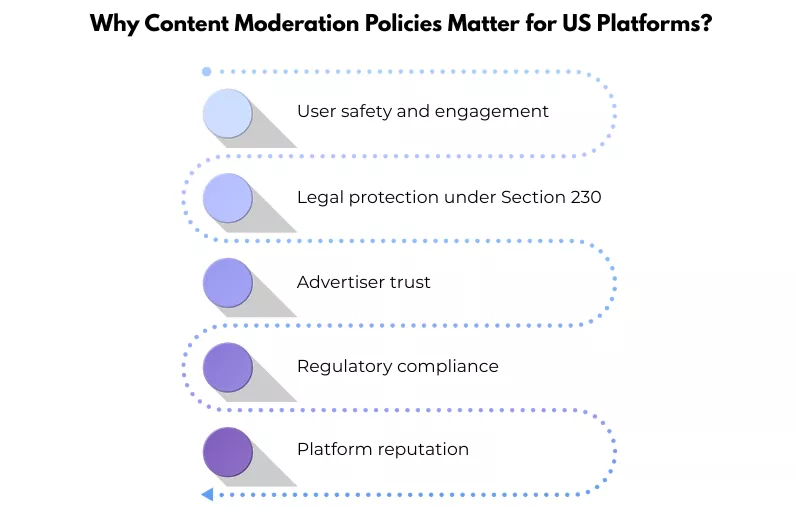
Without a clear content policy, US platforms face cascading problems: users encounter spam, harassment, illegal content, and harmful content; advertisers pull spending; Congressional committees open investigations. For this reason, strong policies are essential:
User Safety and Engagement
Effective content moderation protects users from hate speech, harassment, spam, and harmful content. Research consistently shows that users engage more on platforms they feel safe on.
Legal Protection
Section 230 of the Communications Decency Act shields US platforms from liability for user-generated content, but only when platforms moderate in good faith with clear, published policies. More specifically, Section 230(c)(1) provides broad publisher immunity regardless of whether a platform has a published policy. While a published policy is not the legal trigger for immunity, clear and consistently enforced guidelines are what protect user trust, advertiser confidence, and your platform’s long-term credibility.
Advertiser Trust
Major US brands will not place ads on platforms where their campaigns might appear alongside hate speech or illegal content. As a result, a well-enforced content policy is directly tied to ad revenue stability.
Regulatory Compliance
Federal laws like COPPA and the Kids Online Safety Act (KOSA) have specific content moderation requirements, particularly around protecting minors from harmful content.
Platform Reputation
Consistent content enforcement builds credibility with users, journalists, and the government. Consequently, platforms that enforce their rules fairly become places where people actually want to spend time.
The 6 Types of Content Moderation
There is no single right way to moderate content. Instead, the best approach depends on your platform’s size, user base, content volume, and risk profile. For example, here are the 6 main types:
| Type | How does it work? | Best For |
| Pre-moderation | Content is reviewed and approved before it goes live | Children’s platforms, high-risk communities, government forums |
| Post-moderation | Content is published immediately, then reviewed | Large-scale social and news platforms with high volume |
| Reactive moderation | Content is reviewed only after users flag or report it | Community forums, comment sections, low-risk platforms |
| Distributed moderation | Community members vote on, rate, or flag content | Open communities, wikis, Reddit-style forums |
| Automated moderation | AI and machine learning detect and act on violations | High-volume platforms that need speed and scale |
| Human moderation | Trained reviewers manually evaluate flagged content | Sensitive, complex, or high-stakes content cases |
While these categories define the fundamental methods, most successful platforms in 2026 utilize a hybrid moderation approach.
In addition, by combining the lightning-fast speed of AI with the nuanced judgment of human reviewers, platforms can catch obvious violations instantly while ensuring complex, context-heavy cases are handled with human empathy and accuracy.
If you need support building or improving your content moderation infrastructure, from data annotation services to AI model training and moderation tools, specialized partners can help your platform scale without sacrificing accuracy or user safety.
What Content Moderation Policies Prohibit?
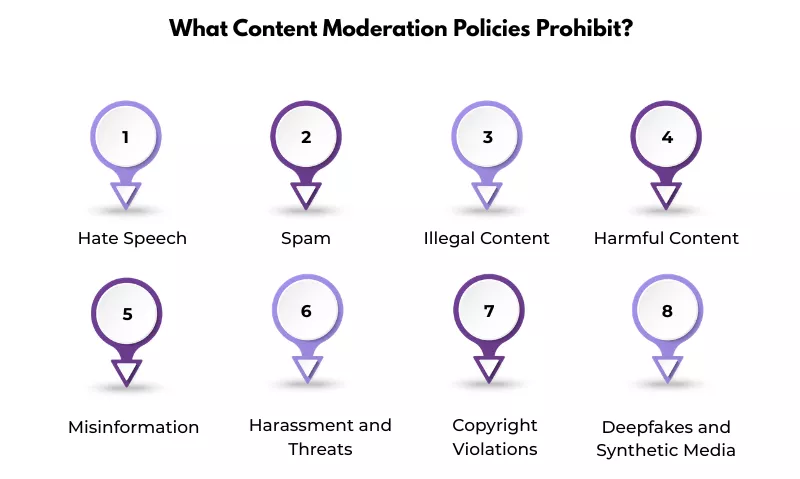
Every platform draws its own lines based on community, audience, and risk tolerance. Nevertheless, most content moderation policies share a core set of prohibited categories. Understanding these is the starting point for writing your own content policy.
Hate Speech
Hate speech includes content that attacks or dehumanizes people based on race, religion, gender, sexual orientation, national origin, or disability. Most US platforms prohibit it outright, although the precise definitions vary. Your content policy should define what hate speech means on your platform, not rely on users to guess.
Spam
Spam covers repetitive, misleading, or automated content posted at scale to manipulate users or game platform algorithms. It also includes:
- Phishing links and fake login pages
- Fake engagement schemes and bot-driven activity
- Deceptive commercial content and unauthorized promotions
Spam detection is one area where automated moderation excels. In particular, AI systems identify spammy patterns far faster than any human reviewer.
Illegal Content
Illegal content has zero tolerance. It includes:
- Child sexual abuse material (CSAM)- platforms must report to NCMEC under federal law
- Non-consensual intimate images
- Content that facilitates drug trafficking or arms dealing
- Terrorism-related material
There is no grey area with illegal content. Remove it immediately and report where required. Furthermore, tools like Microsoft PhotoDNA are an industry-standard protocol for detecting and hashing CSAM, and integrating them into your detection pipeline is considered a baseline requirement for US platforms in 2026.
Harmful Content
Harmful content is more complex. It includes material that hinders online safety for kids and promotes:
- Self-harm and suicide
- Eating disorders and dangerous diet behaviors
- Dangerous viral challenges targeting minors
- Substance abuse
As a result, the Kids Online Safety Act (KOSA) requires US platforms to take reasonable steps to prevent minors from accessing this type of content.
Misinformation
Misinformation, particularly around health, safety, and elections, creates real-world harm. US platforms handle it differently:
- Some add warning labels and reduce algorithmic distribution
- Others remove it entirely for the most dangerous categories
- Some provide links to authoritative sources alongside disputed content
Your content policy should define which types of misinformation trigger which enforcement actions and clearly distinguish misinformation from contested opinion.
Harassment and Threats
This category includes direct threats, doxxing, coordinated pile-ons, and sustained personal attacks. It is one of the most reported violation categories on US platforms, and one of the hardest to moderate consistently, because context matters enormously. A single message that reads as threatening may look innocuous in isolation.
Copyright Violations
Unauthorized reproduction of copyrighted material, music, video, written content, and images creates legal liability under the Digital Millennium Copyright Act (DMCA). Therefore, your content policy should outline your DMCA compliance process, including how users submit takedown requests and how repeat infringers are handled.
Deepfakes and Synthetic Media
Deepfakes and AI-generated synthetic media represent one of the fastest-growing moderation challenges for US platforms in 2026. This category includes non-consensual deepfake intimate imagery, AI-generated CSAM, and synthetic video or audio designed to spread disinformation about real individuals or events.
Moreover, several US states have passed laws specifically targeting deepfake-based electoral interference and non-consensual intimate imagery. As a result, platforms need explicit policies governing synthetic media, including how AI-generated content is labeled, what categories are prohibited outright, and how detection tools integrate with human review workflows.
How to Create Content Moderation Guidelines That Work?

Building content moderation guidelines that function at scale requires more than a list of rules. In other words, you need a full system: policy design, enforcement protocols, team training, and a regular review cycle. Here is the step-by-step process.
Step 1: Define Your Platform’s Values and Scope
Start with your purpose. Ask yourself:
- What kind of community do you want to build?
- Who are your users, age groups, interests, and communities?
- What content should never exist on your platform under any circumstances?
- Does your policy cover public posts only, or also private messages, profiles, and uploads?
Your content moderation for publishing industry should reflect your platform’s identity, not just legal minimums. For instance, a children’s education platform operates under completely different standards than a political discussion forum. Ambiguity about scope creates real gaps in enforcement.
Step 2: Map Your High-Risk Content Categories
Before writing a single rule, map the categories that pose the greatest safety, legal, or reputational risk for your platform. Then build your moderation protocols around those categories first.
For most US platforms, the highest-priority categories include:
- CSAM and content involving minors
- Direct threats and credible violence
- Hate speech targeting protected groups
- Spam and coordinated inauthentic behavior
Platforms in healthcare, finance, or children’s education will have additional high-risk categories according to their regulatory environment.
Step 3: Write Rules in Plain Language
Your users must understand your rules to follow them. Therefore, when writing your content policy:
- Use plain, direct English, no legal jargon
- Give real examples of both what is prohibited and what is allowed
- Explain the ‘why’ briefly for each rule
- Avoid vague language that leaves room for personal interpretation
A rule like “Do not post false statements about real people intended to damage their reputation” outperforms any legal citation. Simply put, people follow rules they understand.
Step 4: Build Your Enforcement Protocols
Rules without clear enforcement are just suggestions. Consequently, define what happens when content is flagged, who reviews it, how long that takes, and what actions are available. Standard enforcement actions include:
- Warning the user with a plain-language explanation and a link to the rule
- Removing the specific piece of content
- Temporarily restricting posting or feature access
- Temporarily suspending the account
- Permanently banning the account
- Reporting to NCMEC (for CSAM) or law enforcement (for credible threats)
Also, define response time targets. Threats and self-harm disclosures need faster review windows than general spam reports.
Step 5: Design Your Appeals Process
Every moderation system makes mistakes. That is why an appeals process is what separates a fair system from an arbitrary one. A well-designed process includes:
- A clear, direct link to the appeal form in every enforcement notification
- A plain-language explanation of the original decision
- A defined response window, typically 24 to 72 hours
- A genuine second review by a human moderator for contested cases
- A clear outcome notification regardless of the final decision
Users who can appeal a decision they disagree with are therefore far less likely to become vocal critics of your platform.
Step 6: Train Your Moderation Team Thoroughly
Your moderation team carries the full weight of your content policy. Strong training includes:
- Complete policy coverage with detailed examples of each rule
- Practice decisions on real, ambiguous, and edge-case content
- Regular refreshers when the policy is updated
- Clear escalation paths for content that requires senior review
Moderator well-being is a serious operational and legal issue. In fact, US courts have seen settlements from platforms including Facebook and TikTok over documented psychological harm caused to moderators by sustained exposure to graphic content.
As a result, build in mandatory breaks, content rotation schedules, exposure limits, and mental health support access. This protects both your team and the quality of your enforcement decisions.
Step 7: Establish a Regular Review Cycle
Using content moderation tools is not a one-time project. Instead, schedule a formal policy review at least every six months. After each review:
- Analyze enforcement data and identify patterns or gaps
- Incorporate user feedback and major incident learnings
- Update rules wherever inconsistencies have appeared
- Publish a changelog; users deserve to know what changed and why
AI Content Moderation Policies: What Platforms Need to Define?
AI-powered content moderation has changed the scale at which US platforms can enforce their rules. Machine learning models scan billions of posts, images, and videos every day, a volume no human team could review alone.
However, AI has real limitations that your content moderation policy must address.
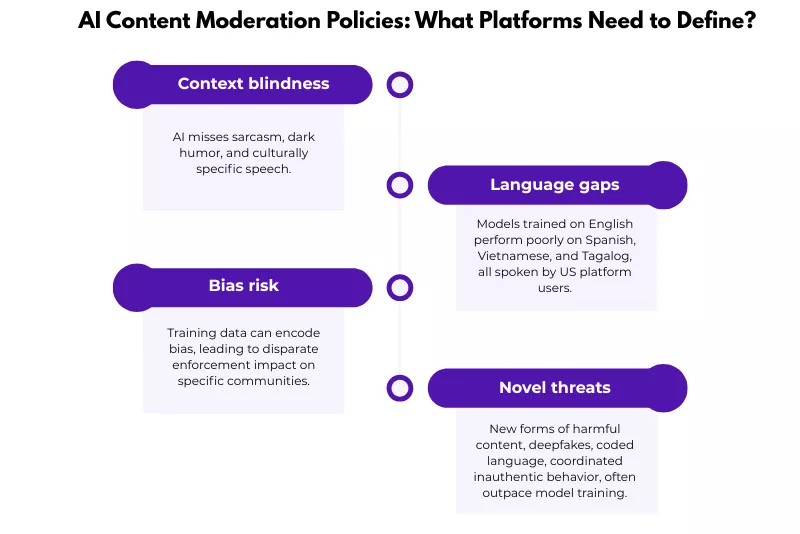
Key Elements of an AI Content Moderation Guidelines
If your platform uses AI for content enforcement, your policy should clearly define the following:
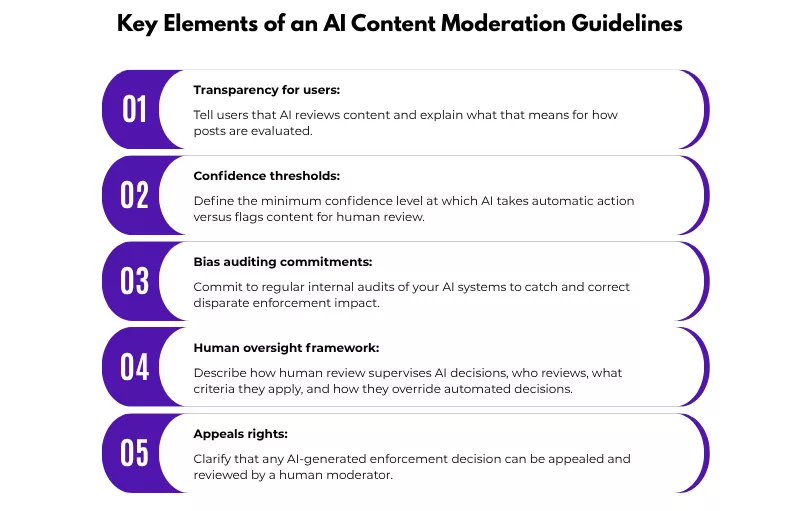
AI chatbot content moderation policies are a growing priority in 2026. Specifically, as US platforms add generative AI tools, they need clear rules governing what these systems can produce and how outputs are reviewed when users attempt to generate harmful content or circumvent platform rules.
Furthermore, there is an active and unresolved legal question in the US as of 2026: courts are increasingly skeptical that Section 230 protects platforms from liability for content generated by their own AI systems, since the platform is arguably a co-creator of that content rather than a passive publisher.
Therefore, platforms deploying generative AI features should consult legal counsel on this point and build explicit output review protocols into their content policy.
Content Moderation Policy for Social Media Platforms
Social media platforms face the most demanding content moderation environment of any platform type. The challenges are significant:
- Content volume that does not compare to any other platform category
- Users spanning all 50 states with diverse cultural backgrounds and expectations
- Content crossing dozens of languages and communities simultaneously
- Constant public scrutiny from Congress, journalists, civil society, and advocacy groups
As a result, a strong content moderation policy for US social media covers these core elements:
| Policy Element | What It Should Cover |
| Community standards | Clear rules on hate speech, spam, illegal content, harassment, CSAM, health misinformation, and copyright |
| Enforcement actions | Defined responses range from content removal and warnings to temporary suspension and permanent bans |
| Transparency reports | Regular public reports on enforcement actions, volumes, error rates, and government removal requests |
| Government requests | A defined process for evaluating and responding to lawful content removal requests from US federal or state agencies |
| Appeals system | A structured, accessible process for users to challenge any moderation decision |
| AI oversight framework | A clear description of how automated systems work, their limitations, and when human review applies |
| Minor protection protocols | Stricter content filters, age verification processes, and reporting obligations required under COPPA and KOSA |
Two additional considerations matter for US social media content enforcement specifically:
First Amendment Context
US platforms are private companies; the First Amendment does not require them to host any particular speech. As a result, content moderation decisions are legally protected as editorial discretion, provided platforms maintain consistent, published policies.
Audience-Specific Guidelines
A content policy that works for one product or community may be poorly suited to another. For this reason, large platforms often maintain separate guidelines for different features — that is a legitimate and often necessary approach.
US Content Moderation Regulations Every Platform Must Know

The US regulatory system for content moderation has shifted significantly in recent years. In addition, federal and state governments are both paying closer attention to how platforms handle harmful content, and new laws are actively reshaping obligations. Here are the key regulations in 2026:
Section 230 (Communications Decency Act)
The foundational US law protecting platforms from civil liability for user-generated content. Section 230(c)(1) provides broad immunity to platforms as publishers of third-party content.
COPPA (Children’s Online Privacy Protection Act)
COPPA requires platforms directed at children under 13 to obtain verifiable parental consent before collecting personal data. It directly shapes content moderation rules around identifying, protecting, and restricting content for younger users.
Kids Online Safety Act (KOSA)
Requires platforms to protect minors from harmful content, including material promoting self-harm, eating disorders, substance abuse, and sexual exploitation. Furthermore, platforms must provide meaningful safety tools for children and parents. However, KOSA has been the subject of ongoing First Amendment and civil liberty challenges from groups like the ACLU and the Electronic Frontier Foundation. These legal battles will determine the extent and constitutionality of its “duty of care” provisions.
STOP CSAM Act
Strengthens federal obligations for platforms to detect, remove, and report child sexual abuse material. As a result, all US platforms must have active CSAM detection, including hash-matching tools like Microsoft PhotoDNA, and mandatory NCMEC reporting protocols.
State-Level Laws
California, Texas, Florida, and several other states have passed platform-specific content moderation laws. In particular, the US Supreme Court’s rulings in NetChoice v. Paxton and NetChoice v. Moody have significantly shaped what states can and cannot legally require platforms to moderate.
These precedents are essential reading for any compliance team operating at a national scale in 2026. Additionally, some state laws continue to face ongoing federal legal challenges. Consequently, platforms operating nationally must track this patchwork and build state compliance into their review cycles.
Best Practices for Content Moderation Policies 2026
These content moderation best practices reflect what high-performing US moderation teams do differently, the decisions that separate effective programs from ones that generate constant incidents and user complaints:
- Write rules specific enough that two moderators reach the same decision.
- Use a tiered enforcement model.
- Document every moderation decision.
- Publish transparency reports regularly.
- Build community flagging into your system.
- Track state-level compliance requirements.
- Audit your AI tools quarterly.
- Invest seriously in moderator wellbeing.
In short, write rules specific enough that two moderators reach the same decision. Use a tiered enforcement model and document every moderation decision. Publish transparency reports regularly; this is now a standard expectation for any platform seeking advertiser trust and regulatory goodwill.
Moreover, build community flagging into your system, track state-level compliance requirements, audit your AI tools quarterly, and invest seriously in moderator wellbeing.
The Role of Data Annotation in AI Content Moderation
Every AI content moderation system depends on labeled training data. Human annotators review examples of content and label them, teaching the model what to look for and how to distinguish violations from legitimate speech. As a result, the quality of that labeling determines how well the AI performs on real content.
High-quality data annotation for content moderation requires:
Detailed Labeling Guidelines
Annotators need precise rules for every content category, including edge cases. Broad definitions produce inconsistent training data.
Inter-Annotator Agreement Checks
Regular processes to verify that different annotators label the same content consistently. Without this, your training data contains contradictions.
Diverse Annotation Teams
Teams should reflect the languages, cultural backgrounds, and regional contexts of your actual users. In other words, a team that does not reflect your audience produces models that do not work for that audience.
Continuous Feedback Loops
Model performance data should flow back into annotation guidelines on an ongoing basis to catch emerging accuracy problems before they scale.
If your platform uses AI-powered content moderation, the quality of your data annotation work is therefore one of the most important investments you will make. Poor annotation produces poor AI decisions, and at platform scale, those decisions affect millions of users.
Final Thoughts
Content moderation policies are load-bearing infrastructure for any US platform in 2026. They protect users from inappropriate content, support Section 230’s good-faith requirements, keep advertisers engaged, and make the difference between a platform people want to use and one they quietly leave.
In summary, the most effective approach combines clear written rules, tiered enforcement, hybrid AI and human review, community flagging, a functioning appeals process, and a regular review cycle. None of these elements works well in isolation; instead, they have to work together.
Frequently Asked Questions
What is the Good Samaritan Provision in Content Moderation?
This is Section 230(c)(2) of the Communications Decency Act, a separate and distinct protection from the general publisher immunity in Section 230(c)(1). In practice, it protects platforms from being sued when they take voluntary, good-faith actions to restrict access to material they consider “obscene, lewd, lascivious, filthy, excessively violent, harassing, or otherwise objectionable.” As a result, it is the legal provision that allows you to enforce your content moderation policies without being treated as the original publisher of the user’s speech.
How Should Platforms Handle Borderline Content?
Borderline content refers to material that does not technically violate your content moderation policies but comes very close to the line, for instance, sensationalism or clickbait that stops just short of being harmful. In that case, best practices for 2026 involve reducing the algorithmic reach of this content (“soft demotion”) rather than removing it entirely. Consequently, this approach balances user safety with free expression while still signaling to the platform’s systems that the content is unwelcome.
What is a Transparency Report, and Should I Publish One?
A transparency report is a public document disclosing enforcement activity, posts removed, accounts banned, government data requests received, and error rates broken down by violation category. For example, Meta and Google publish these quarterly, while TikTok publishes biannually, with each report including breakdowns by enforcement action type and government removal requests by country. Therefore, for US platforms, publishing on a comparable schedule is now a standard best practice to demonstrate that content moderation guidelines are being applied fairly and consistently.
How Do I Handle Moderation for Live-Streaming Content?
Live-streaming requires a low-latency moderation approach. Unlike pre-recorded content, live broadcasts happen in real time, which means you cannot rely solely on human review. To address this, most platforms use AI tools to monitor audio-to-text transcripts and visual frames simultaneously, flagging high-risk broadcasts for immediate human intervention. In the most serious cases, such as when illegal content is detected, automatic termination protocols kick in without waiting for a human decision.
What is the Human-in-the-Loop (HITL) Model?
HITL is a moderation strategy where AI handles the initial bulk scanning and high-confidence removals. However, when the context is ambiguous, those edge cases are sent to human moderators for a final decision rather than being resolved by the algorithm alone. This is the approach used by platforms including YouTube and Meta for categories like hate speech and harassment, where context and intent are critical. Ultimately, it prevents AI over-blocking and ensures that your content moderation policies are interpreted with human nuance where it matters most.

Want To See My Profile — Click Here Robert M. Janicki
- Content Moderation Policies: A Complete Guide for 2026 - May 18, 2026
- AI vs Human Content Moderation: Who Does Better in Content Filtering? - November 21, 2025
- How AI Powered Content Moderation Is Changing Social Media? - September 26, 2025