
Synthetic data in computer vision annotation is artificially generated imagery that is used to train AI models. It combines automatic labels, zero manual effort, and full control over scene conditions. It directly addresses the core challenge of building CV datasets.
Since real-world data is expensive, slow to label, and often imbalanced, this synthetic data fills all these gaps. The global AI training dataset market, driven by these costs, is growing from USD 2.3 billion in 2023 to an estimated USD 11.7 billion by 2032. In this blog, we will discuss all its methods, strategies, real-world applications, and much more.
Key Takeaways
- Synthetic data generates large, labeled CV datasets without manual annotation, which cuts time and cost significantly.
- It covers rare and dangerous scenarios that are impossible or unsafe to capture in the real world.
- The best results come from combining synthetic and real data, which do not replace one another.
- The methods include 3D rendering engines, GANs, diffusion models, and simulation software.
- Managing the sim-to-real gap through domain adaptation and hybrid training is key to production-ready performance.
What Is Synthetic Data in Computer Vision?
Synthetic data refers to artificially generated images, videos, and annotations that are created computationally and not captured from the real world. In the context of computer vision data, it means AI-ready visuals generated using 3D rendering engines, generative models, or simulation software.
It is not like real photos; this synthetic imagery comes pre-labeled. The generation pipeline knows exactly what’s in every frame, including object positions, bounding boxes, segmentation masks, depth, and more. This removes the need for expensive manual annotation.
Types of Synthetic Data Used in Computer Vision
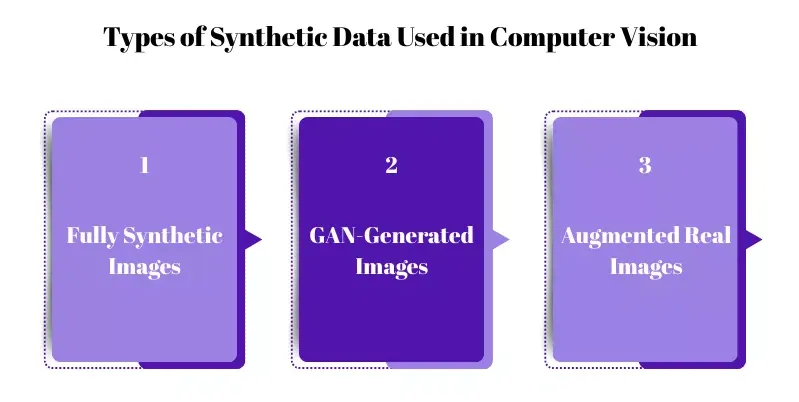
There are 3 main types of computer vision synthetic data annotation services:
Fully Synthetic Images
Built using 3D platforms where every detail, including lighting, angles, and textures, is controlled and annotated automatically.
GAN-Generated Images
It is created by generative AI models like GANs and VAEs. These models learn from real datasets and produce new, realistic-looking samples for data annotation synthetic data.
Augmented Real Images
It is a hybrid method where real image segmentation services are enhanced with synthetic elements like virtual objects, style changes, or modified backgrounds.
How Synthetic Data Generation Works?
Synthetic data generation for computer vision models uses a mix of technologies. It’s core idea is simple: build a virtual environment, take images from it, and export the labels automatically. Here is the whole process:
- Scene design: Developers build 3D environment using different tools.
- Parameter control: Lightning, camera angles, weather, and scene layouts are controlled to create diversity.
- Rendering: The engine outputs photorealistic images using physically based rendering techniques.
- Auto Annotation: Because the system controls the scene, it generates the pixel perfect labels.
- Export: The labeled dataset is packaged and ready for model training.
Why Synthetic Data Matters for Computer Vision Annotation?
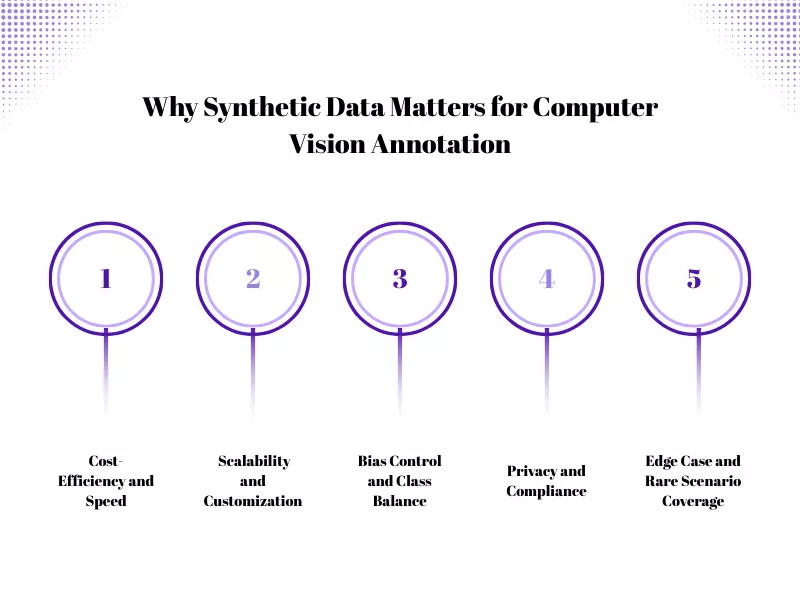
If you see the real-world data collection, then it is very slow, expensive, and on the top of that, incomplete. Synthetic data solves these core challenges that hold back AI development. Here is why it matters for computer vision annotation and the benefits synthetic data CV:
Cost-Efficiency and Speed
Manual data collection and labeling are one of the most expensive parts of building a CV model. Synthetic data platforms can generate various labeled examples in hours. This cuts both the budget and time.
Scalability and Customization
Need 50,000 images of a product under different lighting conditions? Synthetic data will help you with that. You control every variable, including object type, background, angle, weather, etc., without limits. This is one of the best benefits of synthetic data in computer vision.
Bias Control and Class Balance
Real-world datasets are often imbalanced. Some objects or scenarios appear far more than others, which leads to biased models. With synthetic data generation for computer vision models, you can balance classes and make sure it covers everything in all conditions.
Privacy and Compliance
In fields like healthcare and surveillance, collecting real data means dealing with GDPR and other privacy regulations. Synthetic data has no identifiable information, which makes it safe to use, share, and store without any legal issues. This advantages synthetic data annotation computer vision is important.
Edge Case and Rare Scenario Coverage
Some things are impossible to capture in real life. Synthetic environments help you simulate these cases safely and repeatedly, so that your model is ready before they come into the real world.
Methods Used to Generate Synthetic Data for Computer Vision
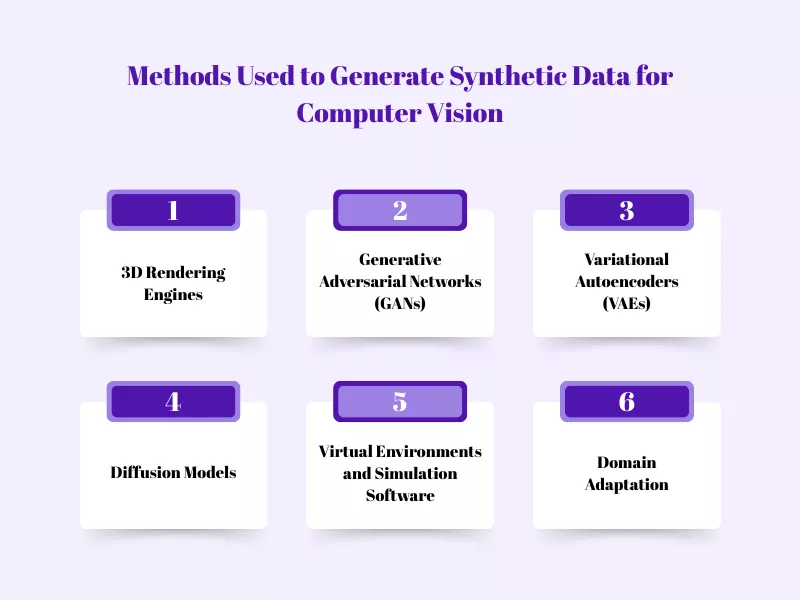
There is no single way to create synthetic imagery. Different methods suit different use cases, team budgets, and realism requirements. Here are the most widely used approaches:
3D Rendering Engines
Many tools help developers to build detailed virtual environments and make photorealistic images from them. Every element, including lighting, camera position, and object placement, is fully controlled.
It is best for industrial inspection, robotics, image annotation for autonomous vehicles, and any use case, precision annotation.
Generative Adversarial Networks (GANs)
GANs use two neural networks, including a generator and a discriminator, which compete to produce highly realistic images. Once they are trained, they can generate new images without labeled input data.
It is best for data augmentation, style transfer, face synthesis, and domain adaptation tasks.
Variational Autoencoders (VAEs)
VAEs encode real images into a compact representation, and then they decode new variations from it. They are more stable than GANs and easier to train, though the output can be less sharp.
It is best for anomaly detection, exploratory data generation, and tasks where interpretability matters.
Diffusion Models
Machine learning diffusion models start with noise and refine it to a realistic image. They power tools and produce some of the highest quality synthetic imagery available today. It is best for high realism augmentation, rare event generation, and a domain adaptation pipeline.
Virtual Environments and Simulation Software
Camera and sensors placed inside these virtual environments capture dynamic scenes with automatic multi-modal labels, including radar, RGB, and LiDAR. It is best for autonomous vehicles, drones, robotics, etc.
Domain Adaptation
This adaptation does not create new data from scratch; it adjusts existing synthetic images to look more like real-world photos. It is best for improving model performance when you have a large synthetic dataset but limited data.
Real-World Data vs. Synthetic Data: A Practical Comparison
Both real vs synthetic data vision types have their own strengths. The key is knowing when to use each and when to combine them:
Strength of Real-World Data
- Captures the actual complexity and noise of the deployed environment.
- Important for final model validation and production testing.
- Reflects the true distribution of real scenarios.
Limitations of Real-World Data Collection
Real-world data is limited as:
- Expensive and slow to collect and label
- Does not have balance with rare events and underrepresented
- Have privacy and compliance risks
- Manual annotation has human error.
Strengths of Synthetic Data
- Scalable, fast, and cost-effective to produce
- Pixel -perfect automatic annotation with zero human error
- Full control over scene conditions and class distribution
Limitations of Synthetic Data
- Can create a domain gap if images are too clean or unrealistic
- Bias can be built into the generation pipeline if not designed carefully.
- Still needs real-world validation before deployment.
The bottom line is that synthetic data vs real data in computer vision is not an either/or debate; the best results come only when you use them strategically.
Combining Synthetic and Real Data for Stronger CV Models

Here are the main hybrid strategies teams use:
The Pretraining-First Approach
Train your model on a large volume of synthetic data first. This makes a strong general representation and pattern recognition. Then fine-tune on a smaller real dataset to adapt to the deployment environments.
Data Augmentation-Oriented Approach
Keep real data as your main source, but add synthetic samples to fill gaps. Use it to cover rare classes, unusual angles that your real dataset does not have. This targeted use of synthetic imagery improves model generalization.
Balanced Hybrid Training
Mix real and synthetic data throughout training in a controlled ratio. Synthetic data provides volume and coverage. Real data helps the model to actual world distributions and prevents overfitting to synthetic artifacts. This ratio depends on your tasks. Test different mixes and validate on real-world benchmarks.
Domain Adaptation and Transfer Learning
When a model trained on synthetic data does not perform well on real images, then domain adaptation bridges the gap. Techniques include:
- CycleGAN: Translates synthetic images into a style closer to real photos while keeping labels intact.
- Adversarial Training: Encourages the model to learn features that work on both synthetic and real input.
- Domain Randomization: Deliberately varies textures, lighting, and backgrounds to force the model to learn domain-agnostic features.
Data Annotation Strategies for Synthetic Datasets
Annotation works differently with synthetic image data. The pipeline already knows what’s in the scene. So, rather than drawing bounding boxes by hand, teams focus on designing good generation pipelines and validating the output.
From Manual Labeling to Automated Ground Truth
In simulation based pipeline, the 3D engine has structured metadata for every frame. This means you get perfect labels automatically which include:
- 2D and 3D bounding boxes
- Segmentation masks
- Depth maps
- Object pose and orientation
- Instance and semantic segmentation
Quality Control and Validation for Synthetic Data
Even though synthetic data removes human annotation errors, it still lacks quality assurance. QA shifts from checking human labelers to validating the generation pipeline, etc.
The steps of QA include:
- Generation design review: Check the scene, including the right texture, conditions, and class distributions.
- Domain expert validation: Subject matter experts make sure that synthetic scenarios are realistic and relevant.
- Utility-based testing: Train models on computer vision systems for generated data and measure performance on real-world test sets.
- Iterative refinement: Update generation parameters as you discover failure modes from evaluation.
Real-World Applications of Synthetic Data in Computer Vision
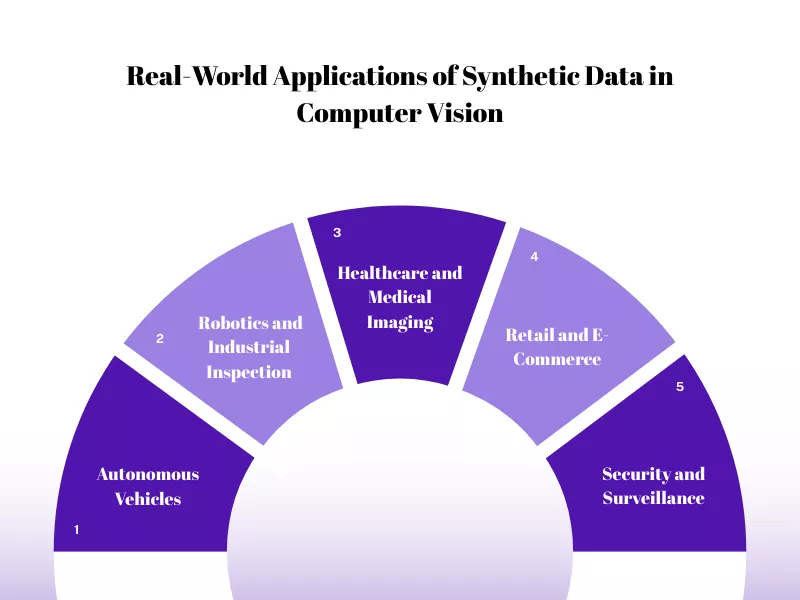
Synthetic data is already being used across industries for training data faster, safer, and smarter AI models. Here are the benefits and use cases that synthetic data offers:
Autonomous Vehicles
A self-driving car system needs to handle thousands of unpredictable scenarios. Capturing different types of synthetic data is difficult to collect. The simulation environment generate complete driving scenario with sensor data and automatic labels. This is why image annotation for autonomous vehicles relies on a mix of real and synthetic training data.
Robotics and Industrial Inspection
Robotics in warehouses and factories needs to detect, pick, and avoid objects precisely. High-quality synthetic data training scene provides the training volume needed without requiring a physical test setup. For industrial inspection, synthetic imagery enables the detection of defects and safety hazards at scale.
Healthcare and Medical Imaging
Medical imaging datasets are small, expensive, and heavily regulated. Synthetic medical data, including X-rays, CT scans, and MRIs with artificial abnormalities. This is one of the biggest advantages of synthetic data annotation, which allows innovation in sensitive domains.
Retail and E-Commerce
Retailers use computer vision for shelf compliance and automated checkout. Synthetic data often has diverse layouts, product placement, and lighting conditions, and synthetic data allows teams to train models and label data for new products.
Security and Surveillance
Surveillance systems need large datasets to train computer vision models. But collecting this data creates serious privacy issues. Using synthetic data via GANs and 3D modelling lets these systems train without involving real identities.
Challenges and Solutions in Synthetic Data Annotation

Here are the challenges and solutions to synthetic data annotation:
The Sim-to-Real Gap
Models trained only on synthetic data do not perform well on real images. Even small visual differences, be it in noise, lighting, or texture, are responsible for performance drops. The solution is to use hybrid training strategies. Combine synthetic and real data. Apply domain randomization and domain adaptation to reduce the gap.
Bias Inheritance and Fairness
Generating high-quality synthetic data alone cannot reduce bias. If the generational pipeline has issues, then it will be inherited by those blind spots. The solution is to set diversity targets in your generation parameter.
Overfitting to Synthetic Artifacts
When models see only synthetic data, they can learn cues that do not exist in real images. The solution is to inject controlled imperfections in your synthetic pipeline and mix use of synthetic data and real data.
Future Trends in Synthetic Data for Computer Vision
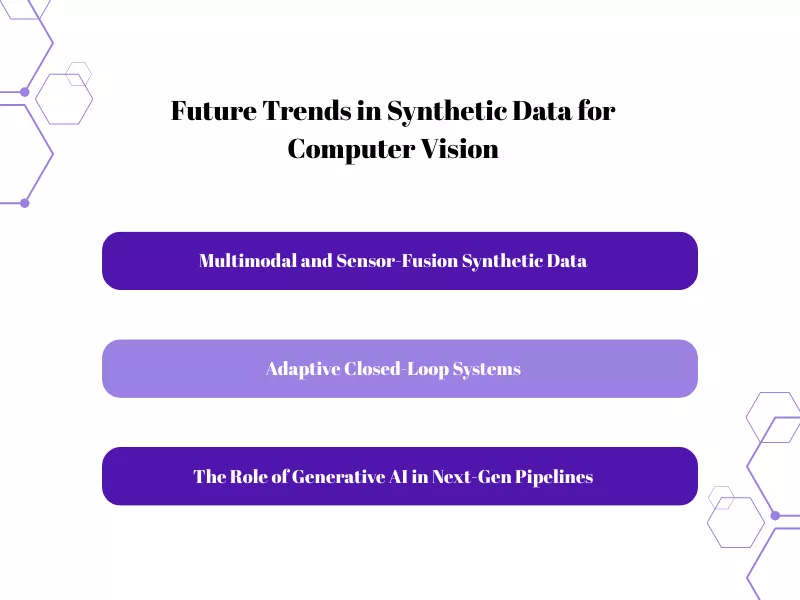
Multimodal and Sensor-Fusion Synthetic Data
Next-generation computer vision systems combine multiple sensors, including RGB cameras, radar, thermal, and event cameras. Synthetic data is already transforming platforms, which are evolving to simulate all these modalities. It is important for autonomous driving and advanced robotics.
Adaptive Closed-Loop Systems
The future of synthetic data is adaptive; instead of static datasets, the simulation is based on real-world model performance. When a model fails in a certain scenario, the system generates more training data targeting the specific failure.
The Role of Generative AI in Next-Gen Pipelines
Generative AI is making synthetic data faster and more accessible. Many models can generate physically accurate video simulations of the entire environment. Diffusion models can turn text prompts into photorealistic training scenes. When these tools mature, the cost and complexity drop.
Conclusion
Synthetic data applications of computer vision are no longer experimental data; it is a practical, proven approach to building better AI systems faster. It solves real problems like data scarcity, annotation cost, privacy constraints, and coverage of rare scenarios.
The best results do not come from replacing real data, it comes from combining it with high-quality synthetic imagery in a thoughtful way. Whether you need annotated data for autonomous vehicle or train defect detection models, synthetic generation data makes it easier to control and scale the real-world collection that simply can’t match.
Frequently Asked Questions
Why use synthetic data for computer vision annotation?
Synthetic data allows you to build large datasets without the cost and time of manual annotation. It gives you full control of scene conditions, covers rare scenarios, and reduces privacy risks.
Can synthetic data improve AI model performance in computer vision?
Yes, when it is used correctly, models trained on synthetic data alone can outshine models trained on real data.
How to combine synthetic and real data for computer vision training?
The best approach is to train your model on large synthetic datasets and then fine tune them on a smaller real-world dataset.

Want To See My Profile — Click Here Martha L. Ritter
- Video Annotation Tools and Software – How They Work and Types - May 28, 2026
- Point Cloud Annotation vs 3D Cuboid: Which Is Better for AI Models? - May 6, 2026
- Machine Vision vs Computer Vision – What’s the Difference? - April 7, 2026