The idea of AI and machine learning models being able to understand visual and textual cues like humans seemed impossible even a few years back. However, with the emergence of multimodal AI, we have seen a revolution where AI can understand various modalities like text, image, speech, physiological gestures, and more simultaneously.
Vision language models are an interesting application of multimodal AI. These models have the ability to process and understand the modalities of language (text) and vision (image). Consequently, these can perform advanced vision language tasks, like visual question answering (VQA), image captioning, and text-to-image search.
In this vision language models guide for beginners and ML teams, we will walk you through the definition, how these models work, and introduce you to a few popular datasets for a better understanding of the concept.
Key Takeaways
- Vision Language Models combine image, video, and text understanding
- VLMs enable tasks like visual Q&A, captioning, and document analysis
- They use vision encoders, language models, and token fusion to align modalities
- VLMs outperform traditional language models in visual reasoning tasks
- Open-source and proprietary VLMs offer trade-offs between control and performance
- Key challenges include cost, complexity, bias, and ethical concerns
What Is a Vision Language Model?
A vision language model is an AI that understands and processes both images/videos and text. The models allow interpretation of visual information along with language to perform tasks like describing pictures, answering questions about images, captioning videos, or even generating images from text.
The models take images and their respective textual descriptions as inputs and learns to associate the knowledge from the two modalities. The vision part allows the model to capture spatial features from the images, while the language model interprets information from the text.
After the input, both data sets are mapped to each other. As a consequence, it helps the model understand and associate an image with a keyword. Unlike the simple computer vision models, VLMs represent a more advanced and evolved version of computer vision.
Moving forward, we will learn how these models work. It will help understand the models better and add clarity to the process.
How Do Vision-Language Models Work?
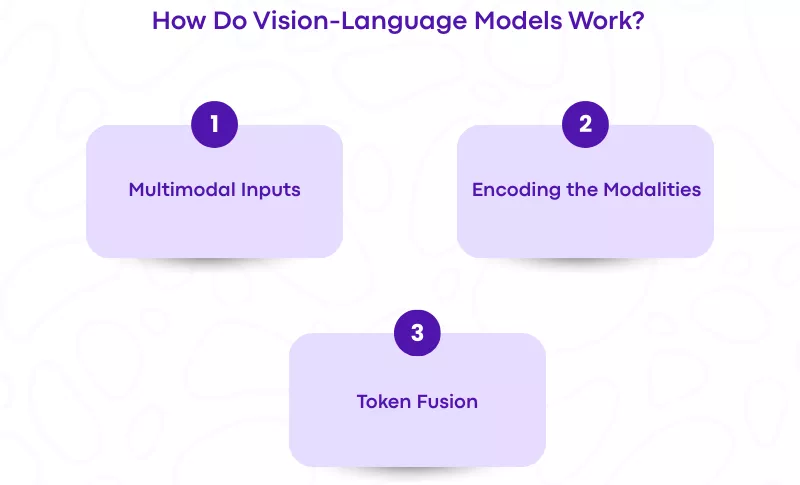
The vision-language models follow a three-step process, starting with the vision encoder converting images into numerical representations, the projection layer maps these to the language model’s embedding space, and the LLM decoder generates text while attending to both visual and text tokens.
Here’s a detailed workflow for a better understanding:
1. Multimodal Inputs
As mentioned earlier, the models get two different modalities as inputs:
First, the visual input, which can be both images or videos
Second, natural language instructions, questions, and commands to guide the models to perform and give the desired output
The second is more important since that is the one driving the entire process. Companies like AnnotationBox offer natural language processing services to help get the right prompts to guide the VLMS.
2. Encoding the Modalities
The text and image inputs are not encoded similarly. The processing steps differ for each modality. Here’s how each of them is encoded:
➜ Vision encoder – This helps transform the visual input into structured numerical representations, known as visual embeddings (z(i)), and is done by Vision Transformers (ViTs), Convolutional Neural Networks (CNNs), or hybrid architectures like ConvNeXt.
➜ Language encoder (or Text processor) – The process converts textual prompts into vector representations, which are known as textual embeddings (Z(t)). It is typically done by Transformer-based Large Language Models (LLMs).
3. Token Fusion
The technique is used to integrate, merge, and align discrete visual and textual token representations from the encoders to improve multimodal understanding. In fact, methods like FrameFusion reduce vision tokens by 70% in video LVLMs with less than 3% accuracy drop. It uses methods like attention-based pooling, concatenation, or specialized merging to improve efficiency and performance. The key aspects of token fusion are:
➜ Multimodal integration – It aligns image patches (visual tokens) and text embeddings (language tokens) in a shared, unified, or closely interacting space.
➜ Efficiency gains – By reducing the number of tokens through aggregation, the models can lower computational costs significantly.
The approaches for token fusion are:
➜ Early fusion – Treats image patches and text as a single sequence of tokens processed together.
➜ Compound tokens – Uses cross-attention to generate compound tokens, fusing text and vision features along the channel dimension.
➜ TokenFusion – This is a specific method that prunes multiple single-modal transformers and re-utilizes units for cross-modal fusion.
The modern LLM vision models mostly use hybrid approaches. Using early fusion in the first few layers help establish visual grounding, which is then followed by cross attention to maintain efficiency in deep layers. Companies like AnnotationBox, offering data labeling services, follow this approach to ensure the accuracy of data.
Understanding the Differences between VLMs and Traditional Language Models
There are a lot of differences between VLMs and traditional language models. Since this is a guide to understanding VLMs for AI and ML models, it is crucial to understand the differences before moving on to the evolution and popular VLM datasets.
Simply put, traditional language models are text only, while VLMs cover all text, image, and video. To simplify the points for you, here’s a look at the key differences between VLMs and traditional language models:
| Feature | Traditional Language Models | VLMs |
|---|---|---|
| Input | Text only | Text and image/video |
| Primary task | Text generation/understanding | Visual reasoning and multimodal analysis |
| Components | Encoder/decoder | Vision encoder + LLM + projector |
| Output | Text | Text (describing/analyzing images) |
| Context | Linguistic/semantic context | Spatial/visual and textual context |
This will help you understand the importance of VLMs. Moving on, we will take you through the VLM architecture, which is again an important part of the guide.
An Insight into the VLM Architecture
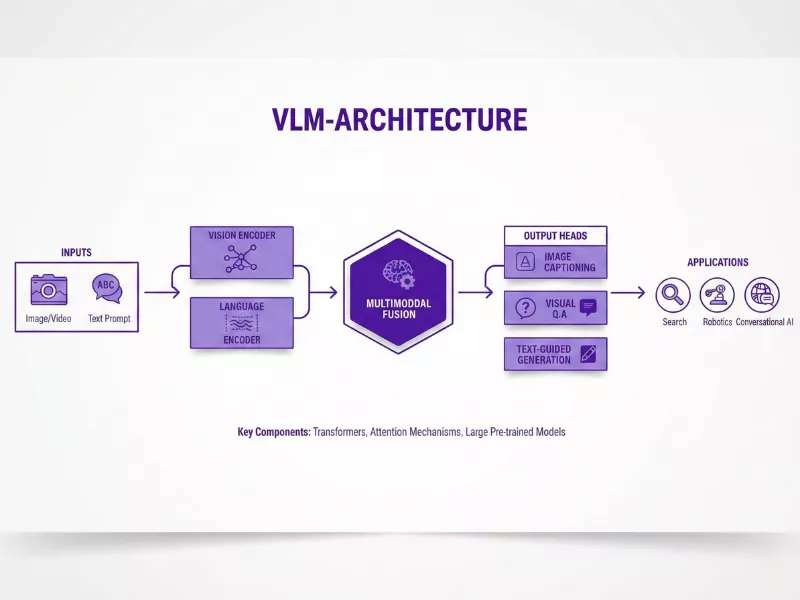
The primary objective of VLMs is to combine image and text processing into a unified framework. The architecture integrates modules that extract and align visual and textual features, enabling seamless multimodal AI understanding and generation. The following is a look at the key components to help you understand the architecture better:
➜ Image encoder – It extracts meaningful features from images by dividing them into patches and processes them using a Vision Transformer (ViT).
➜ Vision-language projector – This is used to align image with text embeddings. It is done by projecting visual features into the same dimensional space with the use of a small multilayer perception (MLP).
➜ Tokenizer + embedding layer – This component helps convert input text into token IDs and maps them to dense vectors to capture semantic meaning.
➜ Positional encoding – The component is used to add spatial or sequential data to embeddings, thus helping the model understand the order and context of tokens.
➜ Shared embedding space – It is used to combine projected image tokens with text embeddings in a unified sequence to allow joint attention over both modalities.
➜ Decoder-only language models – This component is used to generate output text autoregressively, producing tokens one at a time on the basis of integrated visual-textual context.
The following section will take you through a few popular vision language models.
Popular Vision Language Models Datasets
| Model | Release Date | Params | Modalities | Context | Key Strength | License |
|---|---|---|---|---|---|---|
| GPT-4o | May 2024 | Undisclosed | Text, Image, Audio, Video | 128k | Near-instant "omni" response; best-in-class reasoning & creative vision. | Proprietary |
| Gemini 1.5 Pro | Feb 2024 | Undisclosed | Text, Image, Audio, Video | 2M+ | Massive context window; unmatched long-form video/document analysis. | Proprietary |
| Claude 3.5 Sonnet | June 2024 | Undisclosed | Text, Image | 200k | Exceptional at complex document parsing and coding from visual UI. | Proprietary |
| Qwen2-VL (72B) | Aug 2024 | 72B | Text, Image, Video | 128k | Native video understanding; state-of-the-art multilingual OCR. | Apache 2.0 |
| Llama 3.2 Vision | Sept 2024 | 11B / 90B | Text, Image | 128k | Highly efficient "adapter" architecture; strong reasoning for its size. | Llama Community |
| Molmo (72B) | Sept 2024 | 72B | Text, Image | 128k | Pioneered high-precision "image pointing" and spatial grounding. | Apache 2.0 |
| NVLM 1.0 | Sept 2024 | 72B | Text, Image | 128k | Maintains superior text-only performance while matching GPT-4o vision. | Apache 2.0 |
| Pixtral 12B | Sept 2024 | 12B | Text, Image | 128k | Native support for variable image sizes/aspect ratios without distortion. | Apache 2.0 |
Despite the use of relatively small amounts of multimodal data, visual supervision improves experimental interpretation by 10-25% and yields 5-16% gains on text-only scientific reasoning tasks.
The proprietary models lead to absolute performance. However, it locks you into API pricing and prevents fine-tuning. It is recommended that you use them when accuracy justifies costs, and there’s no need for data privacy or custom adaptations.
The open source models presently perform within 5-10% of proprietary models. Here, you can control deployment, fine-tune on proprietary data, and eliminate per-call costs at scale.
Before moving on to the next section, let’s take you through a few details of the models for a better understanding:
A. GPT – 4o
The ‘o’ stands for Omni. It reflects the design as a single all-in-one model. Unlike the older versions, this version can process text, image, and audio simultaneously.
B. Gemini 1.5 Pro
The flagship model of Google is known for its massive ‘short-term memory’. While most models can read a single book at once, this VLM model can go through thousands of pages or hours of video at once.
C. Claude 3.5 Sonnet
This is a favorite model of developers and data analysts. The model is designed as a ‘constitutional AI’ approach, thus making it highly steerable and less likely to produce hallucinations.
D. Qwen2-VL (72B)
The model, developed by Alibaba, is a significant one in the open-weights community. It introduced a ‘dynamic resolution’ feature, which means it can look at images of any size or shape without squishing or cropping them.
E. Llama 3.2 Vision (90B)
The multimodal is developed by Meta. They took their world-class Llama 3.1 text model and added vision adapters to give it a pair of eyes. Companies can run it on their private servers, making it the preferred choice for privacy-sensitive visual tasks.
The Applications of Vision Language Models
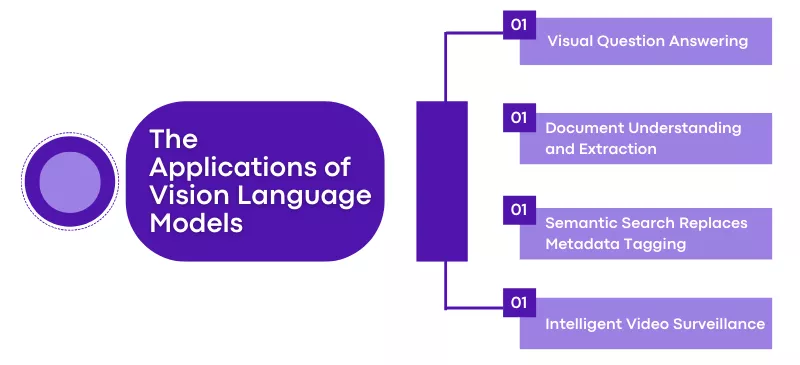
By now, you have understood how these models are important and why companies are using them. However, to make things clearer, here’s a detailed look at the VLM applications in ML:
A. Visual Question Answering
This is very popular in the medical industry, where VLMs are used to get answers to problems that appear in images. Also, companies from the manufacturing industry use the models to identify defects and classify severity. Many other industries use the models for the same purpose.
B. Document Understanding and Extraction
VLMs are designed to read layouts and structures, not just characters. The models understand the difference between a price to pay and a phone number. Insurance companies use these models for extracting policy details. Legal firms also use these models for their operations.
C. Semantic Search Replaces Metadata Tagging
This is very important for e-commerce companies. They use the models to understand customer requirements and share visually matching products. This helps in the proper understanding of customer requirements and provides the right results.
D. Intelligent Video Surveillance
Modern security uses training vision for real-time anomaly detection. Instead of just flagging movement, the AI system can understand context—distinguishing between a delivery person and a suspicious intruder—and provide a model output in plain English describing the event.
Vision language models in computer vision are crucial. However, there are a few challenges and limitations that you must also be aware of.
Challenges and Limitations of Vision Language Models
Undeniably, the VLMs are powerful in understanding visual and textual modalities; they face three primary challenges. Here’s a look at the primary challenges of VLMs:
A. Model Complexity
Each language and vision model is complex, and combining them only increases the problems. The complexity leads to additional challenges in the process of developing powerful computing resources for training, collecting large datasets, and deploying on weak hardware, like IoT devices.
B. Dataset Bias
When VLMs memorize deep patterns within training and test sets without solving any problem, data biases occur. So, if you are trying to train a VLM based on images gathered from the internet, the model memorizes specific patterns without learning the conceptual differences between the images.
C. High Computational Costs
It costs a lot to train and deploy VLMs. This is a major challenge of Vision Language Models. Companies often look for ways to reduce the cost of training and deploying these models.
D. Ethical Concerns
The ethical concerns arise when you use data without consent to train VLMs. It is crucial for companies to keep a check on this while training the models.
Before we end the guide to visual language models, let’s take you through the evolution of these models.
Vision Language Models Guide: How It Evolved over the Years?
The vision language models, as they are today, are a result of evolution over the years. Here’s a look at how the models evolved:
A. Pioneering Models
OpenAI’s CLIP (Contrastive Language-Image Pre-Training), which was released in 2021, was a massive breakthrough in the field. The model was trained on text-image pairs dataset from the internet. CLIP learned how well a text description matched an image, and consequently was able to generate descriptions itself. It became a foundational model for future models.
B. Generative Models
The models now moved from matching to generating. In fact, Google’s Flamingo and Llava (Large Language and Vision Assistant) were built on these ideas. For example, Llava connects the vision backbone of CLIP with a powerful LLM. The model, with the use of a fusion mechanism and fine-tuning the model on instruction following training datasets, it showed the ability to have complex, conversational dialogues about images. This is a step towards the ones that we are seeing today.
The future holds a lot of developments in the field. Here’s a quick walkthrough of the future research:
➜ Better datasets – Experts are working on building better training and test datasets to help VLMs with compositional understanding.
➜ Better evaluation methods – The challenges in evaluation have made it important to research and build more robust VLMs.
➜ Robotics – Experts are also using VLMs to create purpose-specific robots.
➜ Medical VQA – The models can annotate images and recognize complex objects to help healthcare professionals with medical diagnoses.
VLMs continue to evolve and will soon be able to do more than what it is already doing.
Endnote:
Vision Language Models are adding meaning to images, texts, and videos without any external support. The models have helped interpret images and videos. VLMs have made AI better than what it was earlier.
At AnnotationBox, we offer data annotation services to help you get accurate training datasets for your VLMs. We understand the importance of training data for these models and ensure that the datasets are annotated properly to train the models properly.
Frequently Asked Questions
Can Vision Language Models perform object detection and OCR?
Yes. Modern large vision language models (VLMs) have largely replaced different models specifically built for object detection and OCR. Models like Qwen2.5-VL use “visual grounding” to predict bounding box coordinates for objects and “native dynamic resolution” to process image details for multilingual OCR. This enables the model to handle everything from reading dense visual and textual data in PDFs to pinpointing items in a scene.
Which open-source Vision Language Model is best for local deployment?
For local use, Gemma 3 (4B or 12B) and Qwen2.5-VL (7B) are top choices due to their model architecture being optimized for speed. Llama 3.2 Vision (11B) is also a leading open-source vision language option because it is a pre-trained model that fits on consumer GPUs, making it ideal for specific tasks like image captioning and private document analysis.
How do you evaluate the accuracy of a Vision Language Model?
Accuracy is tested on multimodal tasks using benchmarks like MMMU (general reasoning) and DocVQA (document language understanding). Since these are generative models, researchers also use Elo ratings from the Vision Arena, where humans compare the model output of two different models to see which provides a better response to natural language prompts.
Are Vision Language Models capable of understanding video in real-time?
Yes. New models like Gemini 1.5 Pro and Qwen3-VL utilize a massive context window and “absolute time encoding” to understand visual data over time. Instead of just training vision on static photos, these multimodal AI models are trained on video sequences, allowing the AI system to track actions and temporal trends (like “is the person falling?”) in near real-time.
What are the best practices for fine-tuning VLMs on proprietary datasets?
The best practices for fine-tuning VLMs on proprietary datasets are:
- Data collection and preparation
- Fine-tuning strategies
- Use PEFT
- Start with a strong base model
- Freeze/unfreeze strategy
- Instruction tuning
- Proper training and preparation
- Evaluation and iteration
- Managing proprietary data concerns
How can VLMs be efficiently deployed on resource-constrained hardware or edge devices?
To deploy VLMs efficiently on resource-constrained hardware or edge devices, it is necessary to combine model compression techniques, lightweight architectural choices, and specialized inference frameworks.
What are the most reliable metrics and benchmarks for evaluating VLM performance in production?
The core metrics for evaluating VLM performance in production include ANLs, accuracy, LLM-as-a-judge, consistency and plausability, IoU, and hallucination rates. The benchmarks include:
- MMBench/MMTBench
- MMMU/MMMU-Pro
- DocVQA/ChartQA
- MathVista/MathVision
- Compare Bench
- ViLP
- Point-it-out
How can teams mitigate risks of data leakage or adversarial attacks when using VLMs?
Teams can mitigate risks when using VLMs by adopting a layered defense strategy, focused on data preprocessing, input validation, and robust model training.

Want To See My Profile — Click Here Martha L. Ritter
- Synthetic Data in Computer Vision Annotation: Methods, Benefits & Applications - March 12, 2026
- 3D Object Detection: Why It’s Hard and What Matters in Production - February 17, 2026
- A Complete Vision Language Models Guide for ML Teams - February 9, 2026