In production environments, 3D object detection is more about surviving imperfect data and less about simply detecting objects.
The computer vision technique helps identify, classify, and locate objects in a 3D space. The technique estimates the objects’ position, size, and orientation. However, when compared with 2D object detection, this technique is challenging as it requires spatial, geometric, and volumetric data, instead of analyzing flat pixel arrays.
Prioritizing robustness, speed, and data quality over mere accuracy metrics is crucial in this technique. Here, we will take you through the reasons why 3D object detection is hard and what matters in production in detail.
Key Takeaways
- Machine vision focuses on industrial automation; computer vision focuses on AI-based image understanding.
- Machine vision works in controlled environments; computer vision handles dynamic, real-world scenarios.
- Machine vision relies on rule-based systems; computer vision uses AI and deep learning.
- Key uses include machine vision in quality control and robotics, and computer vision in facial recognition, healthcare, and self-driving cars.
- Both share image processing, pattern recognition, and automation goals.
- They can overlap or be combined for better efficiency and insights.
What Is Machine Vision?
Machine vision can be defined as the technology of using industrial cameras, lenses, and software to capture and analyze images, enabling machines to see and make automated decisions.
The technology provides high-speed inspection, identification, and guidance in manufacturing and automation. This, in turn, is typically used for defect detection, quality control, robot positioning, and barcode reading.
Also, machine vision lets automated equipment locate objects, identify them, and save information about their material, condition, orientation, and other details for later analysis. This data is important for factories looking for efficiency gains.
How Does Machine Vision Work?
The process begins with high-quality cameras capturing images of the environment. Then, the specific pre-defined aspects of these images are processed. So, if a machine vision algorithm is trained to detect stop signs in photos, it would only detect that when going through the images of a street.
What Is Computer Vision?
Computer vision is a field of artificial intelligence that is used to enable computers and systems for interpreting, analyzing, and deriving meaningful information from digital images, videos, and other visual inputs.
The technology uses deep learning and algorithms to recognize, classify, and track objects within a scene. The key tasks and applications in the technology include:
- Image classification
- Object detection
- Facial recognition
- Image segmentation
That will give you a basic idea about the differences. However, there are more differences between the two. In the following few sections, you will be able to understand how the technologies differ from each other and how they are used by machines.
Machine Vision vs Computer Vision: Exploring the Differences
The main difference between machine vision and computer vision lies in their scope and application. The focus of machine vision lies in automating specific tasks within industrial or manufacturing settings. It relies on predefined algorithms to inspect or analyze data.
Computer vision, on the other hand, is a broader field of artificial intelligence and mainly focuses on learning, adapting, and extracting insights from images and videos across industries.
| Aspect | Machine Vision | Computer Vision |
| Definition | The focus is on creating algorithms that help systems learn and improve from data | Focus on interpreting and analyzing visual data |
| Scope | The technology includes various techniques that can be applied to numerous tasks and data types | It is limited to image and video data and is a specialized field within artificial intelligence |
| Key Techniques | Supervised learning, unsupervised learning, and reinforcement learning | Image processing, feature extraction, object detection, and pattern recognition |
| Applications | Predictive analytics, fraud detection, natural language processing, and recommendation systems | Facial recognition, object tracking, and autonomous navigation |
| Role in AI Ecosystem | Core area of artificial intelligence, enabling various systems and specialized fields like computer vision | A subset of artificial intelligence, often uses machine learning for processing and interpreting visual data |
That will give you an idea of how these two technologies are different from each other. In the following few sections, we will take you through the applications of both. It will help you understand the differences better.
What Are the Applications of Machine Vision in Business?
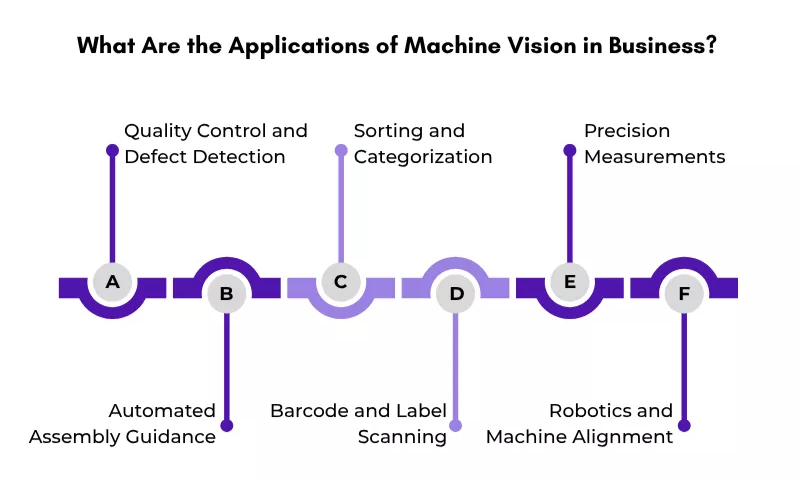
The applications of machine vision are integral to industries willing to improve efficiency, accuracy, and scalability. Machine vision’s ability to automate repetitive tasks while minimizing errors makes it a cost-effective solution for businesses that have high production needs. The applications of machine vision systems include:
A. Quality Control and Defect Detection
Businesses often use machine vision for quality control. It is used to inspect products on production lines for identifying defects and to ensure that only flawless items reach customers. As a consequence, this reduces waste and improves customer satisfaction.
B. Automated Assembly Guidance
Robotic systems with machine vision help with assembly processes. It improves accuracy and reduces production time in industrial vision systems.
C. Sorting and Categorization
The technology helps in the rapid sorting of materials or products on the basis of size, color, or other aspects. As a result, machine vision for quality control helps streamline the supply chain operations of businesses.
D. Barcode and Label Scanning
Businesses often need high-speed cameras to read barcodes or verify labels. Machine vision enables these high-speed cameras to do all the tasks, thus ensuring proper tracking and inventory management.
E. Precision Measurements
Machine vision tools play a significant role in measuring components in industries like aerospace, automotive, and electronics manufacturing.
F. Robotics and Machine Alignment
Tasks like picking, placing, and welding done by vision-guided robotics rely heavily on machine vision. The AI vision technology helps achieve consistency in production processes.
Modern manufacturing and industrial operations use machine vision to help reduce costs, enhance operational efficiency, and maintain high levels of precision. The systems have proved to be useful in addressing numerous critical pain points, like production bottlenecks and quality inconsistencies.
Computer Vision Applications in Businesses
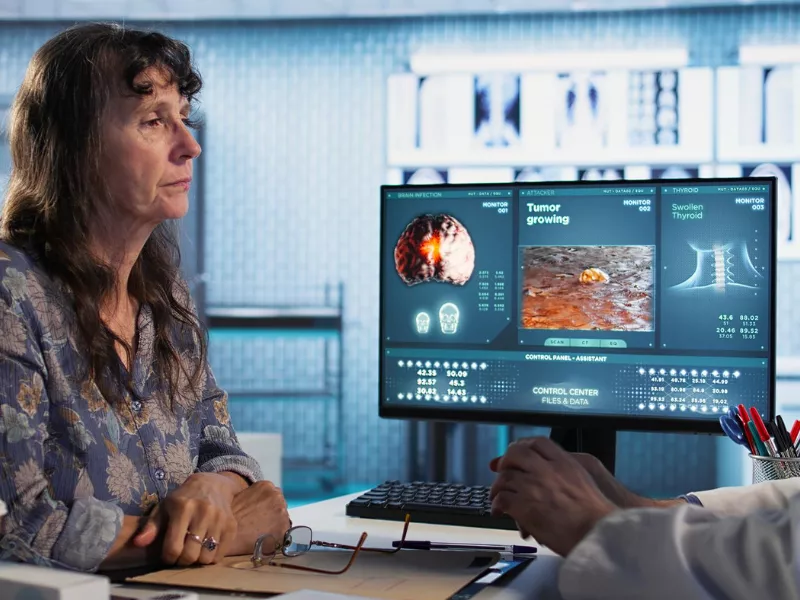
The systems help businesses with the tools to extract actionable insights using visual data. Its usefulness lies in supporting more intelligent operations and innovative solutions. Here are a few applications of the ways computer vision algorithms are used in business processes:
A. Facial Recognition for Security
Businesses often implement computer vision systems for authenticating users, securing facilities, and monitoring unauthorized access. It is to strengthen the operational safety of organizations.
B. Visual Search in Retail
Image-based product searches are common in the retail industry. It helps with proper image annotation for better use. These businesses often use such searches to improve customer experience. The entire process is made possible with the use of these systems.
C. Healthcare Diagnostics
The technology is often used by medical professionals to detect abnormalities in X-rays, CT scans, and MRIs. The technology has helped improve the accuracy of diagnosis and treatment.
D. Autonomous Vehicles
Self-driving cars are examples of proper use of computer vision. It enables cameras and sensors to identify traffic signs, pedestrians, and obstacles to ensure safe navigation.
E. Customer Behavior Analysis
The technology is used to analyze customer behavior in retail circumstances. It helps optimize store layouts and marketing strategies to improve sales.
F. Agriculture and Crop Monitoring
The technology plays a significant role in agriculture and crop monitoring. It is helping farmers to identify crop diseases, measure yields, and optimize resource allocation for higher productivity.
G. Video Analytics for Security
The surveillance systems use this technology for detecting suspicious activities, improving threat detection, and incident prevention.
The various machine and computer vision applications will help you understand how they are different from each other. Further, computer vision in manufacturing helps automate inspection, improve quality control, and worker safety, and enable predictive maintenance. However, there are a few similarities between the two, and it is necessary to know them as well.
What Are the Similarities between Computer and Machine Vision?
While the scopes are different for the two, they are often used interchangeably. The following are a few similarities between machine and computer vision that you must also know about:
A. Core Objective (Visual Analysis)
Both these technologies acquire images or videos, followed by processing, analyzing, and interpreting this data using software.
B. Technical Components
The systems depend on the same fundamental hardware: imaging devices (cameras), lenses, and sensors to capture visual data.
C. Pattern Recognition and AI
The technologies use similar algorithms, often machine learning or deep learning techniques, for identifying patterns, shapes, colors, or defects within an image.
D. Goal of Automation
Both of these technologies work to exceed human visual perception capabilities with respect to speed and accuracy in order to automate tasks.
E. Real-Time Analysis
Machine and computer vision are both used to perform rapid, real-time assessments. They can perform tasks like evaluating items on a conveyor belt (machine vision) or detecting objects in video feed (computer vision).
Adding on, it is necessary to understand how both applications often overlap with each other.
- Quality inspection – The technologies can both be used to detect defects, scratches, or missing components on a production line.
- Object identification – Both are designed to detect, recognize, and segmenting objects in computer vision and machine vision.
- Measurement – The technologies can analyze object dimensions to ensure they meet the specific requirements.
The similarities and differences between these two technologies will help you know about them better. But when the time comes, which one should you choose? The following section will answer the question.
How to Choose between Computer Vision and Machine Vision?

The choice between computer vision and machine vision depends on the specific goals and operational needs. Here are a few criteria to help you understand when to choose one over the other:
A. Environment and Lighting Control
In case your application operates in a controlled environment with fixed lighting, consistent product positioning, and specific, predictable tasks, you must choose machine vision.
For applications that operate in uncontrolled, unconstrained, or dynamic environments where lighting and angles change, computer vision will be the right choice.
B. Task Complexity and Objectives
Rule-based, high-speed, and repetitive tasks like pass/fail inspection, defect detection, component measurement, 1D/2D barcode reading, and robot guidance need machine vision.
Computer vision works well for complex tasks that need a deep understanding, classification, identification, or interpretation of scenes, like facial recognition, medical diagnostics, or anomaly detection.
C. Processing Requirements
For instant, real-time results for driving physical action, like rejecting a faulty item off a conveyor belt, it is wise to use machine vision.
If you can afford higher latency in exchange for more in-depth analysis of images or videos that need extensive, deep-learning based processing, you can go for computer vision. For example, computer vision in sports helps make informed decisions in critical situations.
D. Hardware and Setup
If the solution requires specialized hardware (cameras, sensors, lenses, lights) that need to be integrated with the machinery, consider using machine vision.
In case you are analyzing already captured images or video feeds from generic IP cameras, or if the solution is software-driven and can operate in the cloud or on standard, powerful PCs, you must consider using computer vision. That will help you understand how computer vision differs from machine vision.
Endnote:
While there are differences between machine vision and computer vision, it is also important to understand how both of them play a significant role in modern business enterprises. The application depends on how you run your business.
Traditionally, computer vision is used to automate image processing, and machine vision is basically an application of computer vision in real-world interfaces, like a factory line. That will answer all the questions about computer vision vs machine vision for AI applications and also the similarities between them.
Frequently Asked Questions
Why is scalability important in image and vision computing?
As production demands and data volumes grow, vision systems must scale without requiring a full rebuild. Scalable architectures ensure consistent performance across multiple lines, locations, or use cases, making them a long-term investment rather than a single-purpose solution.
Can machine vision systems use AI and deep learning?
Yes. While traditional machine vision relied on fixed, rule-based logic, modern systems increasingly integrate deep learning models like CNNs to detect complex or variable defects. This smart machine vision approach combines industrial speed and reliability with AI-driven adaptability.
Is image processing part of machine or computer vision?
Both. Image processing is a foundational step that prepares raw visual data, through noise reduction, filtering, and segmentation, for analysis. Machine vision uses it for inspection decisions; the technology uses it before applying AI models. On its own, it involves no recognition or classification.
Does machine vision require a camera, while computer vision does not?
Machine vision is built around dedicated hardware, cameras, lighting, and processors, making a camera essential. It is software-centric and can work from pre-saved images without a dedicated capture device, though in practice most deployments still use cameras.
What industries benefit the most from machine vision?
Manufacturing, automotive, food and beverage, pharmaceuticals, electronics, and logistics benefit most. These industries share a common need for high-speed, precise, and repeatable visual inspection that humans cannot perform consistently at scale.
Can machine vision and computer vision be used together?
Yes, and it’s increasingly common. Machine vision handles fast, structured tasks like label verification, while computer vision manages complex analysis like subtle defect classification. Together, they create a layered system that is both fast and intelligent.

Want To See My Profile — Click Here Martha L. Ritter
- Machine Vision vs Computer Vision – What’s the Difference? - April 7, 2026
- Synthetic Data in Computer Vision Annotation: Methods, Benefits & Applications - March 12, 2026
- 3D Object Detection: Why It’s Hard and What Matters in Production - February 17, 2026