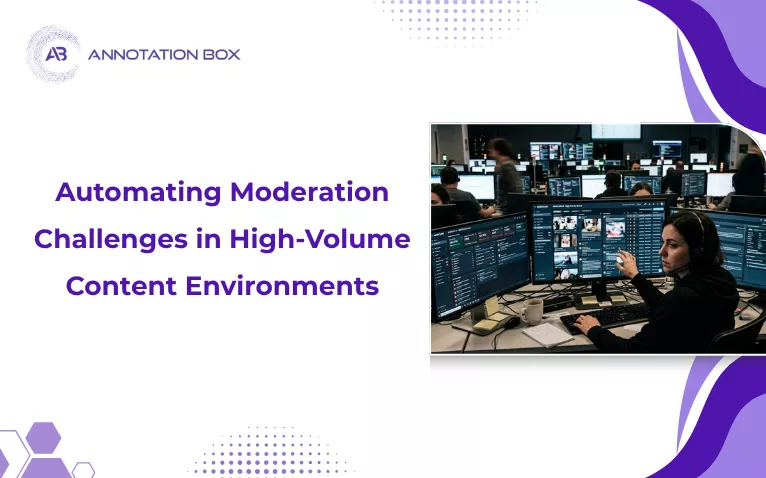
While automatic systems can process millions of posts in real time, they lack the ability to understand the intent behind user posts and complex cultural context. While being quick can be a great advantage, there are serious dangers in solely depending on them, such as false bans and harmful missed threats. Understanding Automating Moderation Challenges is crucial for creating a safe, fair, and compliant online environment while maintaining user experience and brand integrity.
Key Takeaways on Automating Moderation Challenges
- Automation is not nuanced enough to understand more complex human intent.
- High-quality systems are based on a combination of machine speed and human judgment.
- Algorithmic reliance may involve significant legal, reputational, and operational risks.
- It’s important to take a proactive approach to addressing AI moderation challenges rather than a reactive one.
- Systems must be continuously refined through human feedback in order to adapt to changing bad actor tactics.
What Is Automated Content Moderation?

Content moderation services refer to the process of moderating, monitoring, and filtering content generated by users on platforms, according to community guidelines and legal requirements. Automated content moderation involves using software and AI to perform these tasks.
What Are the Biggest Challenges of Automated Content Moderation?

Automated content moderation uses AI technology to moderate digital content at scale, but it struggles to reflect the nuances of human communication, context, and biases. Here are the key challenges of automated content moderation:
- Algorithmic and Dataset Bias: Algorithms and datasets are likely to reflect societal or creator bias and may distort other dialects or minority viewpoints, leading to differential censorship. Solutions involve employing more than one data collection service to ensure that all demographics are represented, not just the majority.
- Missed context and nuance: AI systems could fail to detect sarcasm, irony, historical discussion of hate speech, and cultural memes as malicious, or not detect them at all.
- Evolving Language: Bad actors regularly find new ways to use the language of typos, emojis, and slang (“algospeak”) to get past automated filters.
- Multilingual Disparities: Lower-resource or regional languages get lower algorithmic accuracy, leading to higher false positives and unflagged harmful text.
- The “Black Box” Problem: Algorithmic decision-making is hard for platforms or users to understand as to why certain content was taken down or kept up.
- Balancing Free Speech with Over-Moderation: It’s hard to maintain the right balance, and overly aggressive automation can lead to false positives, meaning that innocent users can be silenced and legitimate conversations prevented.
- Real-Time Stream Processing: Handling high-speed data such as live streams or sudden traffic surges requires significant computational resources and quick decision-making. To deal with these traffic surges, there needs to be strong and scalable data processing services that are capable of handling the high computational load and low latency.
Can Automated Moderation Keep Up with New Slang and Emerging Harmful Content?

Automated moderation cannot completely keep up with quickly evolving slang and emerging harmful content on its own. However, it improves continuously through hybrid human-AI oversight.
When new slang is coined (e.g., a new term for a drug, a political dog-whistle, or a coded insult), it takes time for this to proliferate on the internet, be captured in training datasets, and be fine-tuned into an updated model.
The models are trained with past data. The traditional automation approach was based on “blocklists” and keyword matching. This is basically incapable of keeping up with new slang since slang terms are often polysemous (have more than one meaning) and context-dependent.
Borrowing from cybersecurity’s idea of a “zero-day” exploit, bad actors use new language to try to get into the “blind spot” between the introduction of a trend and the next model change.
The new harmful content is often disguised in everyday vocabulary. For instance, a coded message may be sent regarding an emerging violent event, where the words are innocuous but take on a specific and dangerous meaning in a private subcommunity. This won’t be detected by an AI trained on common definitions, as the wording is seemingly harmless.
A machine learning model is trained by human correction loops to recognize new trends in language over time.
How Is Generative AI Changing Content Moderation?
Moderation is now an arms race as the threat landscape is changing fundamentally with the introduction of Generative AI.
- Deepfakes and NCII: The high quality and rapid growth of synthetic, nonconsensual intimate images (NCII) have surpassed hash-matching systems, which can only identify images that have already been recorded.
- AI-Generated CSAM: Bad actors are also leveraging generative models to produce photorealistic illegal content that has never been seen before and therefore cannot be identified through database comparison or hash-matching.
- Synthetic Spam and Bot Text: Generative AI allows bad actors to create endless variations of spam, bypassing filters that look for repetitive, identical content.
- The Detection Arms Race: When models produce more human-like content, detecting it becomes less accurate, as AI-generated content can closely replicate human speech patterns.
- Limits of Provenance: Watermarking and C2PA (Coalition for Content Provenance and Authenticity) signals are useful, but not always available. Provenance metadata and watermarks can be lost or undermined by re-encoding media by bad actors, making moderation systems unable to recognize the media’s origin.
Can Automated Moderation Reliably Handle Images, Video, Audio, and Text Together?

Automated moderation can process text, images, video, and audio together; it’s not yet a fully independent system.
Although the current multimodal large language models (MLLMs) have made substantial progress in handling context across various media types, they are currently used alongside human moderators. They are not “reliable” in the sense of being error-proof or able to make independent nuance-sensitive decisions because of the automation issues discussed above.
A combination of human and artificial intelligence, with the former taking on the more subjective and high-stakes aspects of the decision-making process, is a common strategy used to reduce safety and fairness issues.
What Happens When Automated Moderation Systems Make Mistakes?
Instead of understanding, AI makes use of statistical patterns. Sometimes automated content moderation makes errors, especially when algorithms are not given the human ability to understand context, nuance, and intent. Automated content moderation algorithms can lead to over-censorship, have false positives, and cause algorithmic bias. These systems break down at points such as:
1. False Positives in Content Moderation
A false positive in content moderation is when something safe and legal is marked as violating policy by a content moderation system. This is commonly known as over-moderation and can result in unfair account bans or content removals.
2. False Negatives in Content Moderation
This is the opposite of a false positive. A false negative is when a system or moderator filters out restricted or inappropriate material as safe. Consequently, hate speech, spam, and graphic imagery, for example, can pass through the cracks and be seen by the user.
Automated content moderation failures also lead to a lack of accountability and transparency. Numerous systems simply reject the boilerplate without providing an accessible human appeals process, or any explanation of their decision.
Is AI-Only Content Moderation Reliable for a High-Volume Platform?
The sole use of AI for content moderation on a high-traffic platform carries significant risks from a strategic, legal, and operational perspective, beyond the technical limitations of the AI models. The pace and cost savings lure lead to the “AI-only” temptation, but it presents structural risks to the viability of the platform.
A system with 99.9% accuracy is statistically risky even on a high-volume system. For example:
A 0.1% error rate on a content platform that pushes out 100 million pieces of content per day leads to 100,000 mistakes every day.
These 100,000 mistakes result in a large amount of “support debt” (user requests, public relations crises, legal issues). The expenses involved in dealing with the fallout can quickly outweigh those of adding human review from the start. In our previous blog on AI vs human content moderation, we explored this in depth.
What US Laws Affect Automated Content Moderation?
Platforms function in a dynamic regulatory environment and are subject to rules affecting certain forms of distress.
- Section 230: Section 230 protects platforms from being treated as the publisher of user content. It also offers safeguarding of good-faith decisions about removing or limiting objectionable content, encompassing most moderation decisions.
- The TAKE IT DOWN Act: Platforms must implement a procedure for removing nonconsensual intimate images. Platforms are required to delete the image and identical copies within 48 hours of a valid request. This extends to real images as well as “digital forgeries” (deepfakes). Civil penalties for non-compliance are up to $53,088 per violation. The FTC began enforcing these requirements on May 19, 2026.
- CSAM Reporting: Platforms have a mandatory duty to report Child Sexual Abuse Material (CSAM) to the National Center for Missing & Exploited Children (NCMEC) once they become aware of it.
- COPPA: The Children’s Online Privacy Protection Act has strict criteria for data collection for children under 13, which affects how moderation data is collected and stored.
- Kids Internet and Digital Safety (KIDS) Act (H.R. 7757): The House passed this package 267–117 on June 29, 2026. It now sits with the Senate, where its path is uncertain. If enacted, it would add age-verification, targeted-advertising, and AI-chatbot safeguards for minors.
- EU DSA: US platforms that also attract EU users have to meet the requirements of transparency and risk management under the Digital Services Act. Some select to utilize aspects of these requirements in worldwide terms.
How Do You Measure Automated Moderation Accuracy?
These are the key metrics that must be measured to manage a system.
- Precision and Recall per Policy Category: Precision measures the percentage of removals that were actually violations. Recall is the percentage of the overall violations the system identified. High recall reduces the number of false negatives; high precision reduces the number of false positives.
- Health Metrics (False Positive/Negative Rates): At scale (see above example), even a small error rate results in significant numbers of wrongful actions.
- Prevalence: Percentage of all content views that include violating content. It reveals the extent of damage experienced by users.
- Appeal Overturn Rate: High rates of successful appeals are signs of ‘over-modding’ or rule misinterpretation by the automation.
- Time-to-Action: The time it takes for a moderation decision to be made after a post is uploaded.
- Language and Dialect Gaps: Error rates need to be broken down by region and language to determine if a language barrier is present or if the system is failing minority groups or non-English speakers.
How Can Platforms Reduce False Negatives in Automated Moderation?

Platforms need to move away from keyword matching towards a multimodal contextual analysis and proactive threat hunting approach to minimize false negatives in automated moderation.
- Cross-Media Synthesis: Detects hidden threats based on text, audio transcription, image analysis, and video OCR that are analyzed by unified multimodal models. Training models with expert-labeled visual data is crucial for accurate detection, and this is frequently provided by high-quality image annotation services .
- Semantic Embeddings: Identify posts by their meaning and purpose rather than specific banned terms, even if they are misspelled, using vector search.
- Risk Scoring: Add account age, network activity, rate of posts, IP anomalies, and other metadata to the mix in order to identify and flag suspicious activity even when the text is seemingly clean.
- Coordinated Inauthentic Behavior (CIB) Tracking: Identifies bot networks and raid groups that simultaneously blast slightly modified versions of harmful content using graph machine learning.
- Threat Intelligence & Red-Teaming: Keep track of malicious subcultures to map new emojis and slang (such as “algospeak”) and then conduct a red-team exercise against them, updating them regularly.
- Low-Confidence High-Risk Queues: Set a lower threshold for placing ambiguous but high-risk items in a queue for human review, assuming fewer false negatives than review speed.
- Feedback from Appeals: If users are successfully able to appeal to the system, the AI should be able to learn from their inputs, finding out what nuances or subverted words it is missing. Platforms must continuously fine-tune the system using proper data and must depend on professional data annotation services to ensure that the newly learned samples can satisfy the strict quality requirements.
How Do You Prevent Bias in AI Content Moderation?
To tackle bias in automated content moderation solutions, it is crucial to go beyond mere model adjustments and delve deeper into the root causes of skew within digital ecosystems. AI models are typically trained on historical social biases found in the data. If they are not corrected, they start to link the idea of “harm” to certain groups, dialects, or cultural expressions.
So, how can automated moderation reduce bias? Active and structural intervention is needed all the way through the machine learning lifecycle instead of passively watching.
- Adversarial Counterfactual Testing: Adopting testing methods that involve swapping out protected features, such as race, gender, or religion, on test samples. If the model changes its decision just due to the change in an identity term, the system is biased and should be retrained.
- Labeling Data with Diversified Annotation Teams: The humans that annotate data and build ground-truth sets should reflect the global user base. Heterogeneous teams may lack a shared understanding of certain aspects of culture. This results in models that are misguided or that prejudge non-dominant groups.
- Inclusive Dataset Balancing: Platforms should make an effort to work on a dataset for underrepresented languages, vernaculars, and regional contexts. A model trained on “standard” speech patterns will mistake informal and/or dialect-rich speech as “suspicious”.
- External Fairness Audits: Internal teams often have blind spots. Third-party auditors can stress-test systems for “disparate impact” to uncover unjust outcomes that may be unintentionally created by developers.
- Continuous Demographic Monitoring: Monitor gaps in language and dialect over time and retrain if the error rate of a group is moving away from the baseline.
- Confidence Threshold Calibration: If there are types of content or groups where a model has greater uncertainty, it should be automatically sent to a human. This prevents the system from being forced to make a potentially biased “guess” on sensitive categories.
How to Make Automated Moderation Decisions Transparent
If you want to turn a black box into a defensible system, focus on transparency.
- Policy-Specific Notices: If content is removed, a notice should include the specific policy being violated (e.g., “Violates Harassment Policy, Section 4.2”) instead of a generic “content removed” message.
- Decision Audit Logs: Platforms should keep their own records of the reasons for a decision, so that a review can be conducted rapidly if the appeal arises.
- Trackable Request Status: Make sure users can view the status of their appeals in a dashboard, fostering accountability on the platform.
- Transparency Reporting: Make annual public reports of the number of pieces removed. Also track the percentage of content covered by AI and successful appeal rates. For platforms targeting an EU audience, this enhances trust and facilitates compliance with DSA reporting requirements.
When Is Human Review Necessary in Automated Content Moderation?

While AI can identify patterns, it lacks moral sensibilities and cultural understanding, which are necessary for important decisions. There will be times when the legal, ethical, and reputational consequences of an error are too great to be left to the algorithm.
Human review is not simply a fail-safe for mistakes, but it is a necessary component of policy enforcement when it comes to complex social environments. Here’s when human moderators should review AI moderation decisions:
- Satire, Parody and Artistic Expression: Algorithms can get confused. A computer trained with AI can identify a photo of a war zone and classify it as a “violent scene,” while a human recognizes it as “journalistic documentation. The human has to decipher the meaning of the creator versus the literal message.
- High-Severity Risk Management: Content that relates to self-harm, suicide,e or real-world physical threats is not a case of simply being removed. These cases require a more human response, like identifying immediate danger or calling the local emergency department – something that a lot of platforms already give prompts for.
- Permanent Account Actions: Artificial Intelligence should not be the only executioner, judge, and jury when it comes to who is permanently banned. If an account is used for part of a user’s livelihood or social identity, human intervention should be considered before the decision, because it is necessary to ensure that the decision is in line with the values of the platform and that no legitimate account is lost due to a system error.
- Unpredictable News Cycles: In emergency situations such as breaking news, protests, or politics changing in real time, content moderation policies frequently need to be applied in real time as well. Algorithms that are based on static data will not comprehend the current zeitgeist nor the evolving definitions of sensitive words during a crisis.
- Final Appeal Reviews: If a user appeals an AI-driven moderation decision, its review shall be made by a human. This gives rise to a layer of “due process”. It enables the platform to check whether the AI has misunderstood the context, language, or an outdated rule.
How to Build a Hybrid Human-AI Moderation Workflow
For efficiency, there should be a hierarchy of tasks. Let AI handle scale, and humans handle complexity.
- Hash-Matching Pre-Filter: Blocking of known illegal content happens immediately before the AI analyses the content; the first line of defense (e.g., images that match industry hash lists are blocked).
- Classifier Scoring: AI gives each piece of content a risk probability score.
- The Three Confidence Bands:
- Manual Approve: High-risk content will need to be approved manually before being pushed out.
- Auto-Action: High-confidence violations are removed automatically when they are detected.
- Human Queue: Ambiguous content is sent to human moderators for review.
- Severity-Based Review SLAs: Urgent threats (e.g., self-harm, live violence) should be treated immediately, before the regular “queue”. Other deadlines also exist independently of these situations, such as 48 hours to remove items under the TAKE IT DOWN Act.
- Escalation and Retraining Loop: All human decisions are added to the AI to “retrain” the models to lower future ambiguity and increase the accuracy of the automated classifier.
How to Protect Human Moderators in a Hybrid System
Human moderators may go through psychological trauma due to exposure to harmful content. Ensuring their protection is a structural necessity.
- Tools for Moderation of Graphic Imagery: Graphic imagery should be automatically blurred or turned to grayscale before reaching a moderator’s screen in order to minimize the initial psychological impact.
- Exposure Caps: Cap the amount of time a moderator can spend reviewing high-severity content per shift.
- Queue Rotation: Rotate staff between “high-risk” queues (graphic violence) and “low-risk” queues (general spam) so that the same staff is not repeatedly exposed.
- Counseling Availability: Ensure mandatory, free, and available psychological counseling for all members of the safety team.
- The industry standard: Facebook settled with its content moderators in the United States in 2020 for $52 million, which resulted in muted-by-default audio, black-and-white video review tools, access to licensed counselors, and group therapy. These measures have become a widely referenced benchmark for moderator wellness programs.
Conclusion
To ensure platform safety, platforms need to strike a balance. Automation is key to handling huge amounts of content, but it’s no magic bullet. Technical systems can never be general enough to cover intent, context, and ever-changing languages. Platforms can reduce risks through comprehensive human oversight, clear appeal policies, and ongoing policy revisions. Finally, technology is only a means to an end: human intelligence is key to a safe and fair online community.
Frequently Asked Questions on Automated Content Moderation
Why Does AI Moderation Miss Harmful Content?
AI fails at content moderation because it lacks understanding; it relies on probability. It reads data, such as certain words or pixel combinations, but doesn’t “understand” the context. When the input contains no statistical characteristics of a violation, the AI will likely label the content as “benign” if a new type of harm arises that is not in the training data, or if the content uses metaphors not in the training data.
Does automated moderation impact user engagement?
Yes. Filtering is aggressive and inaccurate, which frustrates users and reduces participation. Repeated takedowns of legitimate content can make users feel restricted and tempted to go elsewhere.
How do costs compare between human and automated moderation?
While the costs of automation are lower per unit, there are also many ‘hidden costs’ like legal, PR crisis management, and the development of custom software. Human moderation has a cost, but for high-risk decisions it can reduce long-term operational and reputational risk.
Can AI detect emotional manipulation in comments?
While many moderation models rely on scoring toxicity, they aren’t necessarily focused on emotional manipulation. There are certain phrases that are very polite but cause psychological harm, and that’s what gaslighting or passive-aggressive behavior might be.
Is "off-the-shelf" moderation software sufficient?
Typically, no—the generic software does not have any context for the community standards of a platform. For high-volume platforms, it may be advantageous to use custom-trained models suited to the platform’s user behavior, regional slang, and unique vocabulary.

Want To See My Profile — Click Here Martha L. Ritter
- Multilingual Data Annotation: A Practical Guide to Planning, Quality, and Cost - November 11, 2026
- Data Annotation Vendor Checklist: A Practical Guide to Choosing a Provider - October 31, 2026
- Automating Moderation Challenges in High-Volume Content Environments - October 6, 2026